Romano Family Ravioli
t says: Sometimes, there exists a dish that you can eat continuously, no matter how satiated you may feel. Your mouth takes over your brain (much to the chagrin of your stomach), and your only thought is “must … keep … eating”. There are only a few dishes that can do this to me – one of them is g’s grandfather’s ravioli.
Affectionately referred to as “pop-pop” (among other choice words, right Frank?), g’s grandfather possesses a recipe for ravioli stemming from his childhood, back when his family actually sold ravioli. Trust me, selling ravioli in the area where we grew up was probably not an easy task, given that every Italian family (and there’s a lot of them) likely had their own recipe. But, while I haven’t sampled every Jersey family’s ravioli, g’s grandfather’s is the best I have encountered.
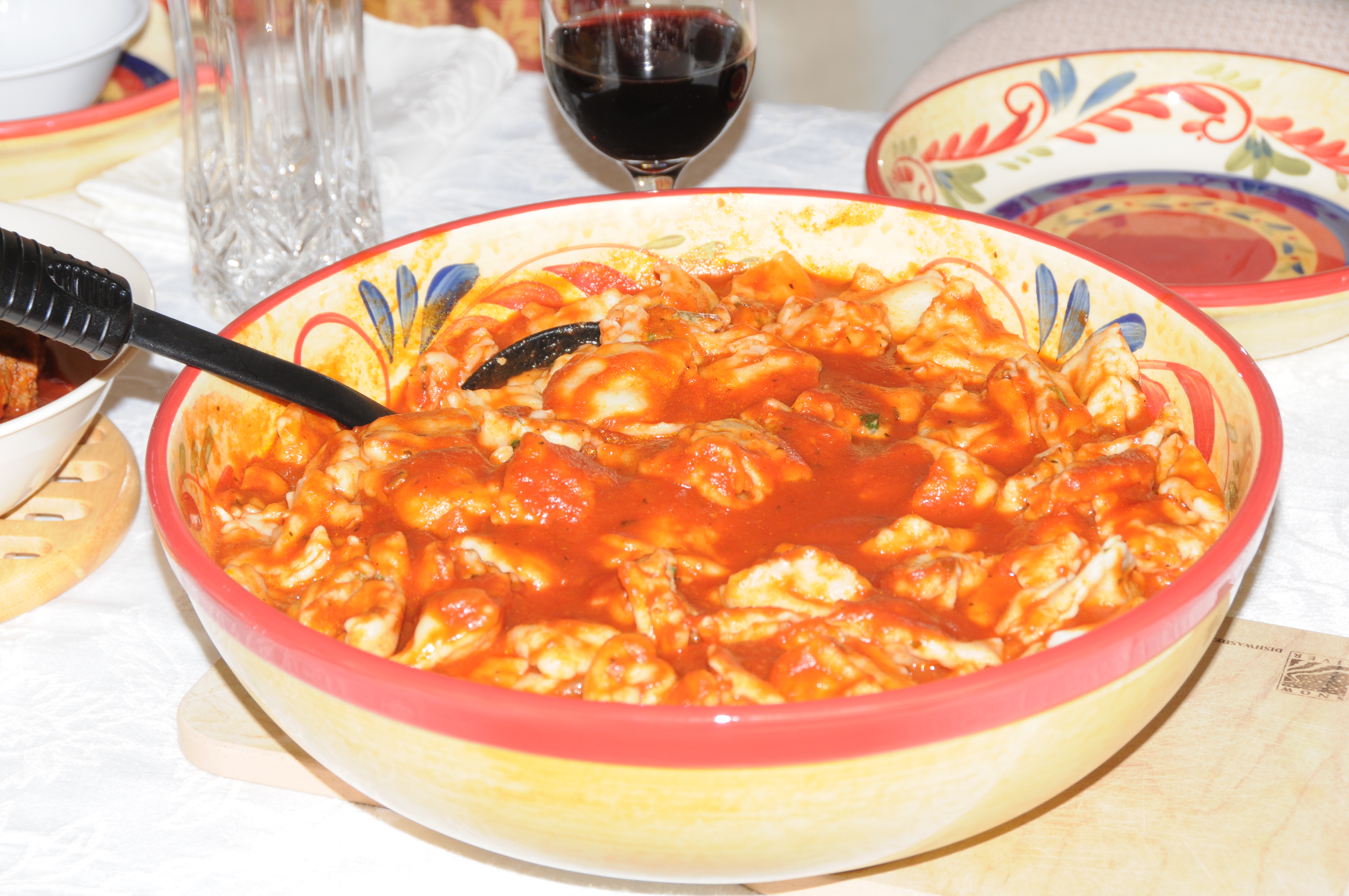
Looks plain, but you have no idea ...
So how do you make these fabled ravioli? Well, the easiest way is to make it with him. g and I have done this, acting as his helpers. I noted that no single action is particularly “hard” or “difficult” or “impossible” – but doing it “just right” requires a certain finesse that apparently only comes with years of practice, a commitment to perfectionism, and a “critical” eye to recognize when something’s working well or needs to be tweaked. It requires a ravioli “marker” (think rolling pin with divots to shape the ravioli), a piece of equipment that no Williams Sonoma or Kitchen Kapers carries. Finally, the ingredients are very specific – there is a very particular way in which the ground veal must be sourced (so I’ve been told). The flour: it absolutely must be Pillsbury brand all-purpose flour.
Unfortunately, if I told you anything more, I’d certainly have to kill you …
Bibou: Cozy and Delicious
t says: As we sat in Meritage on the Saturday of the first big snowstorm we’ve ever experienced in Philly (and what turned out to be the first of many snowfalls for the 2009-2010 winter), we realized that, in all likelihood, restaurants were going to be empty the next day, as the accumulation was >20″. So was there any place that we’ve been dying to try but just couldn’t get a reservation? One name came to mind: Bibou. So the next day, g camped out on opentable.com and waited for someone to cancel their reservation – which they did! Sooo … we aerated/decanted a bottle of ’05 Bordeaux (from the Left Bank), hailed a cab, and off we went! We had effectively squeaked into Bibou!
Unfortunately, a lot of time has passed between now and when we ate, so our memories of the components of each dish are a little fuzzy – but our general impressions are intact and below for your consideration.
12/2009, Sunday 5:30pm, Party of 2, $45 4-course dinner. We were seated promptly at a two-top near the window, which would have been nice, but, because it was snowing, it was quite drafty! We inched away from the window a little bit and went for our wine to give us a nice warm feeling inside. Fortunately, the service was so good that I felt that our location was made up for.
For our first course, we both went with the white bean soup. It was warm and creamy, but still very light and inviting. I was not concerned with filling up on soup.
For our second course, g had the oxtail terrine and I had the escargots. g’s terrine was a cold dish, and she was surprised that she liked it as much as she did, as she’s not the biggest fan of oxtail. I felt that the escargots (with fava beans) outshone the terrine. They were amazingly tender and in a garlicky sauce that tastes “like home”. Don’t be confused – I never had escargots when I was growing up (I’ve actually only had them a handful of times) and I don’t make them in my apartment, but there was something about this sauce that felt homely – it was simple but delicious. After I devoured the snails, g and I proceeded to sop up every last drop of the sauce with our bread.
For the entree, I had the lamb (+$8 premium), while g went for the hanger steak. I remember that the lamb was superbly cooked and well-seasoned – it was a solid, delicious dish of lamb. I unfortunately can’t remember much of the other flavors they coupled with the lamb because I also tasted g’s dish. Hers was better. This was shocking because I love lamb. While I only took a few bites of hers throughout the meal (we like to share), I can say that hers was the best hanger steak I’ve ever had (something about their seasoning, their sauce, and the texture of the meat was as tender as a braised short rib!). Now I know why every restaurant keeps trying to serve it!
We went for the optional cheese plate which gave us three super-flavorful cheeses (no wussy cheeses here). While we don’t know a whole lot about cheese (except for that we like cheese), we appreciated that they picked cheeses with a variety of tastes and textures. That said, g and I are not huge fans of blue cheeses, so we gravitated towards the other 2.
For dessert, we enjoyed the buche de noel and the slice of cranberry pie. While the yule log was an excellent dessert, it didn’t really put forth a ton of flavor; it was simple and to the point: chocolate cake and creamy vanilla filling. It was like a good dessert one could make at home (if one routinely makes buche de noel at home). I preferred the pie. First, the size of our slice of pie was very large for a dessert course – I wonder if they were just trying to get rid of it? Even if they were, and gave us an entire pie, it wouldn’t have mattered – I would have eaten it all. The cranberry tartness was salient but balanced well by the sweet. The filling was not too stiff and not too runny – right on! The crust wasn’t soggy, either. Once again, this was a simple [well-executed] dessert with no frills, however, as you might be guessing, I finished the entire slice, even though I was full – I couldn’t help it.
In summary, Bibou offered a nice, cozy atmosphere and delicious, no-frills food. The hanger steak and escargots were shining stars, while the desserts (that pie!) were a pleasant, simple period on the end of a great meal (Zahav has more of an exclamation point). These, in combination with a great bottle of wine made up the best meal we’ve had since Cochon (it’d be a tough time figuring out who’s better).
Big Brother vs. Creepy Neighbor
A crazy local news story broke recently about the ability of school authorities to remotely activate cameras of district-issued laptops for high school students when the laptops were off-site (e.g. in the homes of the students). I’m assuming that the students were unaware of this feature and the potential for its abuse. Furthermore, there are allegations of its abuse and a lawsuit filed. Check out more:
Bold Flay-vors Coming to Philly
t says: Some people love Bobby Flay. Some people love to hate Bobby Flay (often referencing the epic Morimoto vs. Flay battle on the original Iron Chef). Regardless of which you are, surely you’d be interested in the spring opening of Bobby’s Burger Palace in West Philly. As a Flay-hater, I know that I’ll definitely go and try one of these burgers in the hopes that it will single-handedly change my mind about him. Additionally, surely my patronage will make up for all of those hurtful, sarcastic comments I’ve made about him over the years (e.g. I’m sure that “what these burgers lack in appearance, they’ll make up for in flavor”). But, if/when the flavor doesn’t make up for it, I’ll just have to comfort myself by writing a scathing review (and visiting Capogiro that’s right around the corner … you know … the one that serves gelato and alcohol – why aren’t there more of these?) …
P.S. Yes, I do love that Tony Luke beat him in the cheesesteak throwdown and that Morimoto beat him in the recent Iron Chef America battle.
Zahav: Impressive Flavors with a Superb Finish
t says: k had a day off. I have a flexible schedule. The result? Lunch at Zahav!
2/2010, Friday Lunch, Party of 2, Restaurant week. This was my second visit to this restaurant and it definitely trumped my first experience (a dinner in August 2009 – see “Oh the places we’ve gone …”). My lunchmate k and I made a 2pm lunch reservation, but had to call the restaurant to let them know we would be a few minutes late (silly Center City traffic). Although their kitchen closes for lunch at 2, the staff was very nice over the phone, thanked us for our notice, and didn’t rush us at all as we ate (although perhaps they rushed us a little to place our order when we first got there – understandable).
Our waiter was an interesting combination of nice and “chill”. While the manner in which he spoke was reminiscent of someone who was, shall we say, “high”, he seemed sincerely invested in ensuring that we enjoyed our meal, with frequent visits to the table just to make sure everything tasted “good”. He also warned k that a dish she was about to order (Morrocan fish stew) was extremely spicy and averted what could have been a disaster for her. In short, we thought he was both “unique” and great.
The first course consisting of salatim (salads) and hummus was delightful and as bright as I remembered. They’re still putting together flavor combinations that are new to me, which I enjoy immensely (I found myself constantly returning to the spicy pickled carrots). Perhaps this isn’t fair for other restaurants featuring Asian flavors, as I then have certain expectations of what to taste, but don’t hate the player, hate the game.
For our first main course, I had the ?braised? lamb shank in a pastry shell topped with sesame seeds which was exactly what I needed on a cold winter day – I don’t think I’ve ever had so tender a lamb (and it was seasoned perfectly). k went with a dish featuring roasted beets and chickpeas. They didn’t “blow her away”, but were “regular good beets”; she was more impressed with the combination of normal and al dente chickpeas – we think the latter may have been fried, but remain unsure. Regardless, the chickpeas offered a brand new flavor-texture combo.
My second course, the hanger steak was good – not as good as Bibou’s, but on par with Meritage. Despite being seasoned well, I think I would have preferred if it was cooked a little more evenly (one side of each chunk was considerably more rare than the other) and maybe one more chunk of the meat, as the dish seemed a little bare. k had the swordfish which was cooked perfectly – I blinked and it was gone, so I assume it was awesome.
The desserts were phenomenal – perhaps the best desserts of any Philly restaurant that I’ve visited. We shared the panna cotta, pistachio baklava, and passionfruit sorbet dessert. The super-tart and intensely fruity sorbet coupled well with the creamy panna cotta. And while k found the baklava nothing to sneeze at, I, as someone who loves pistachio and baklava was wondering why no one had thought of this sooner. We also had some sort of chocolate-hazlenut dessert with salted toffee and cumquat – it had a perfect balance of salty, sour, and sweet (and chocolate). I will have to make it a point to combine chocolate and cumquat in the future. These two dishes (as I can’t pick a favorite) were the best ending to a meal I’ve had in a LONG time.
In summary, despite my rocky first visit, I’d be willing to concede that Zahav’s best dishes can live up to the hype that it’s given on the Philly food scene. And this was during restaurant week (i.e. a time which most people say the quality suffers due to the sheer volume produced)! I once read that the New York Post suggests that Zahav is to Israeli food as Momofuku is to Asian food – that’s a quite a bold statement (which I’m not sure I agree with); nevertheless, I wish them the best of luck in striving for that level of success!
Salt-Entombed Striped Bass (with pix)
t says: We saw this beautiful salt-entombed fish on Iron Chef America (followed by raves from tasters), and Thomas Keller has a great photo of one in Ad Hoc at Home; but it never occurred to us that we could actually do this ourselves. g and I rarely cook fish – it’s not that we don’t like it, but we fear screwing up when cooking it (no one likes dry fish) when it’s way more expensive than, say, chicken (and it doesn’t keep that well, either). Our friends who have no such fears and share similar television-viewing tastes to ours, were also intrigued by salt encrusted fish; however, they actually had the activation energy needed to make a plan and execute a Sunday night dinner. They invited us to join their scheme and off we were to Reading Terminal Market to purchase a large [to us] striped bass. We settled on Wan’s seafood (despite the better reputation and cleaner appearance, John Yi’s striped bass had a little glaucoma) and watched as they scaled and gutted it. We joined up with our friends, k and cm, and, guided by a few recipes, we prepped the fish, we cooked the fish, and we ate the fish. Poor Herbie never stood a chance. The whole procedure ended up being quite simple (with minimal prep time, as the fishmonger did all the hard work), but the results were phenomenal – both for our eyes and our mouth. Why hadn’t someone told us that this is the easiest way to cook tender, juicy fish, ever? Below is the recipe that we constructed (adapted from Thomas Keller’s and Alton Brown’s recipes). It was so easy and delicious that we did it again the following day (with Herbina) just to make sure it wasn’t a fluke – it wasn’t (g’s cousin, d, informed us that indeed, it wasn’t … it was a striped bass).
Ingredients:
__ 1 striped bass gutted and scaled, fins and gills removed, head and tail intact (4-4.5 lb in weight before gutting). We have read that snapper and tilapia are similar to striped bass and therefore may be substituted – we haven’t tried it [yet].
__ 3 lb kosher salt (Diamond Crystal brand is what we used – we used Morton’s once and the proportions were all wrong – stupid variable coarseness between brands) (n.b. If you use a larger fish, you will have to use more salt, as the listed amount was perfect for the size fish we purchased)
__ 4 egg whites
__ 0.75 c water
__ handful of flat-leaf parsley
__ 0.5 bulb (+ fronds) of fennel, cut in half (so you’ll have two quarters of the bulb)
__ 0.5 lemon, sliced into at least four slices
__ 0.5 orange, sliced into at least four slices
Methods:
0) Set oven to 425 degrees.
1) Rinse and pat the fish dry. Stuff with fennel, lemon slices, and parsley.
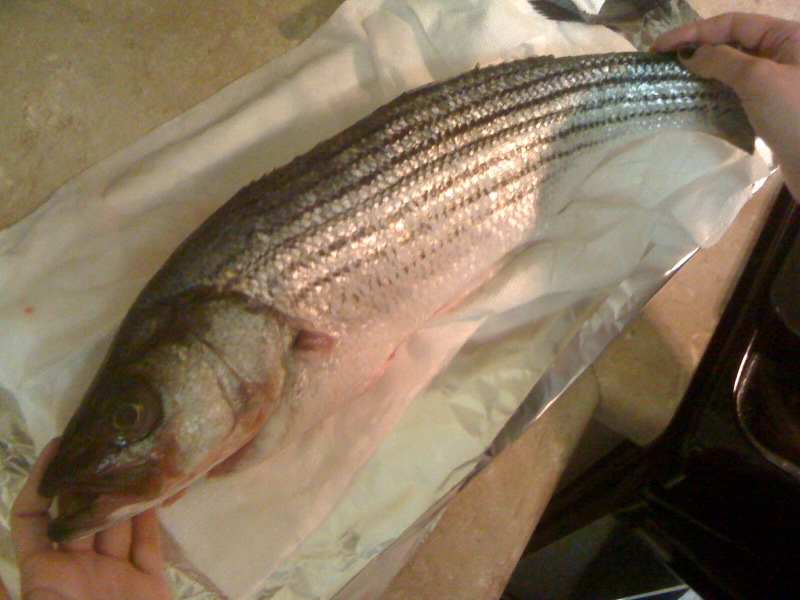
Meet Herbina. Isn't she pretty?
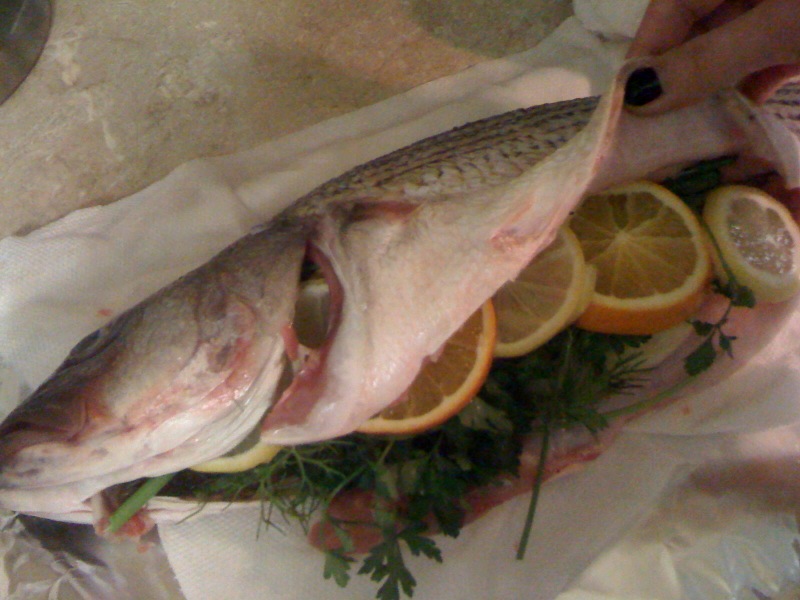
Herbina's stuffed.
2) Combine salt, eggs, and water in a bowl. Hand-mix.
3) In a pan (lined with aluminum foil for easy cleanup), put a half-inch thick layer of salt mixture to lay the fish on (just a little bigger than the fish’s actual size). Place fish onto its salt (kind of like a body in a chalk-outline at a crime scene). Lightly pack salt to completely cover the fish. We used the entirety of the salt mixture for our sized fish. Some exposed tail is ok (we had to cut the tail because of the small oven). You don’t have to suture the slit where you stuffed the fish, just close the wound manually and cover with salt to keep closed. When you’re done, give it a look over to ensure there are no obvious cracks.

"It's like burying your feet in sand at the beach!"
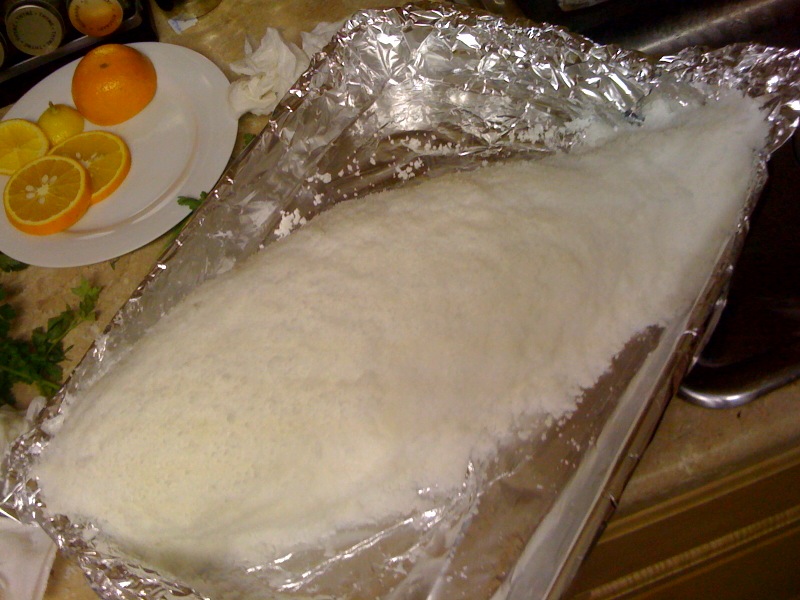
Where'd she go? Into her sarcophagus! (macabre, I know)
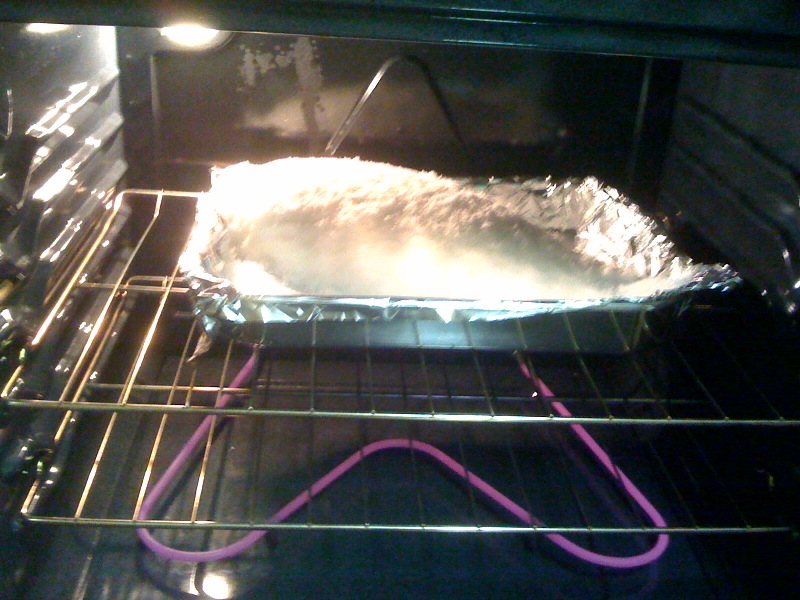
Herbina's in a sauna.
5) In a dramatic fashion, crack the crust with a stern stroke of a large spoon or a mallet or a [clean] hammer. Attempt to remove the crust in large pieces if possible; try not to accidentally pierce the skin and introduce salt to the tender meat underneath, especially when removing salt from the open slit where you stuffed the fish.
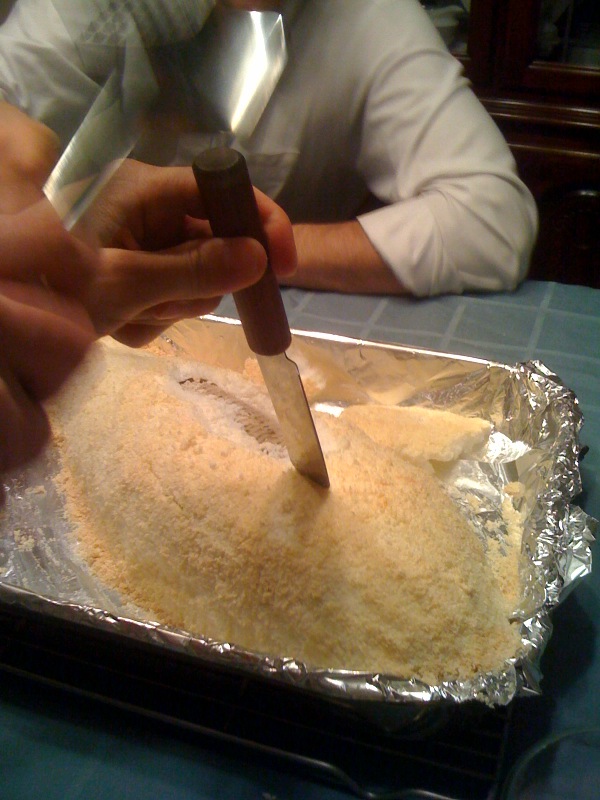
Hammer and chisel (i.e. butter knife).
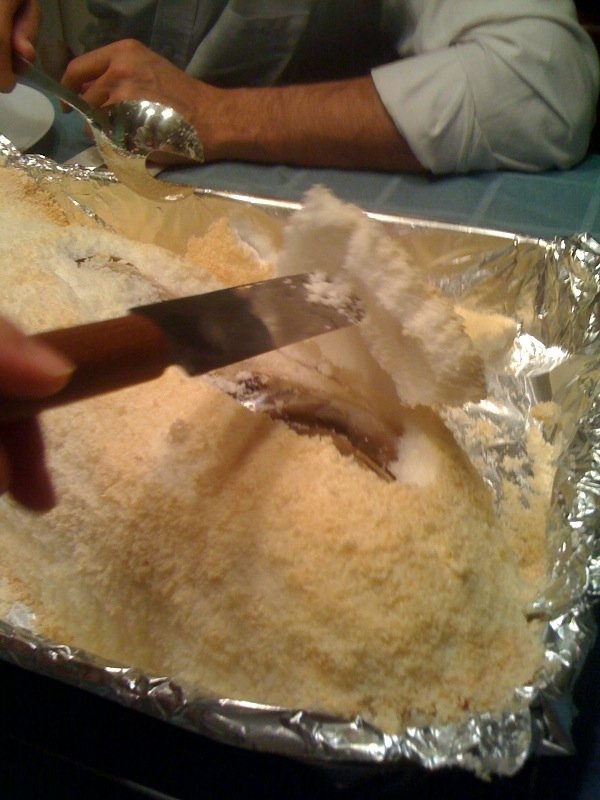
Look inside! It's Herbina!
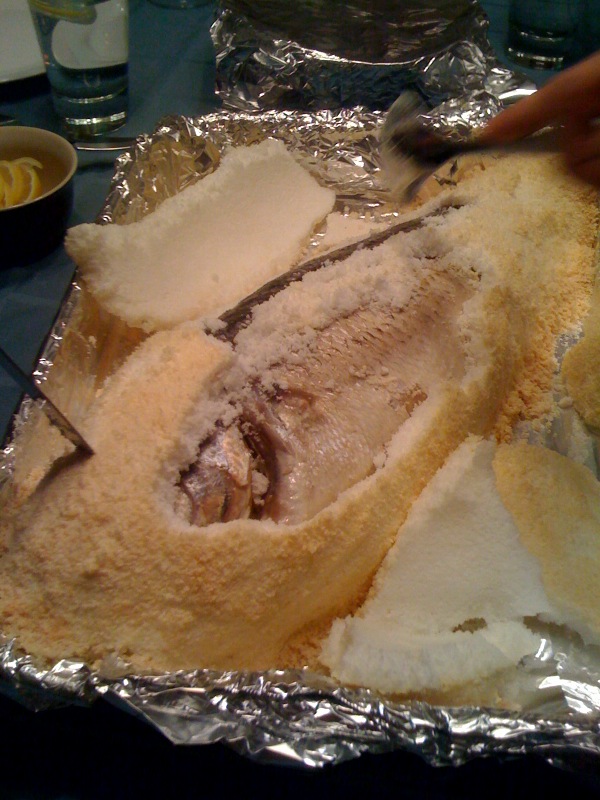
She's almost free!
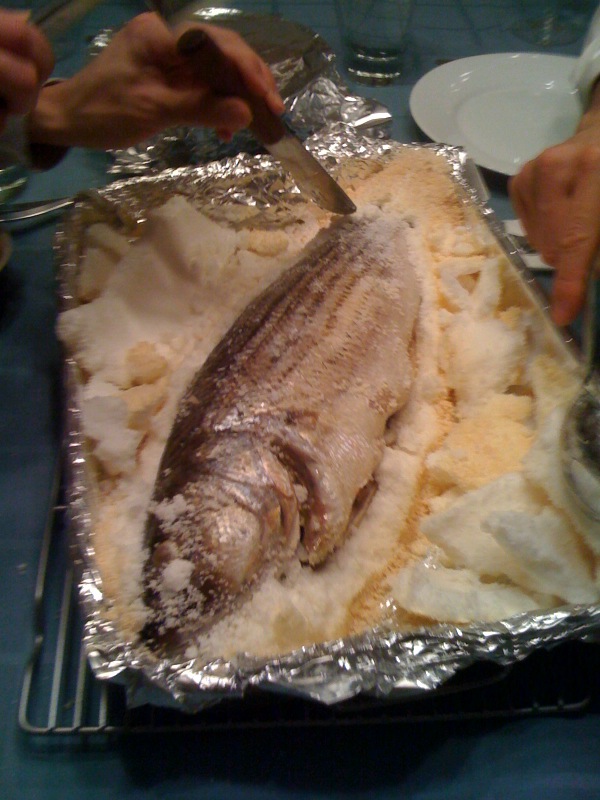
Free at last.
6) Remove the skin from the exposed side of the fish. Remove the exposed fillet of meat resting on the ?spine?. Remove the ?spine?, bones, and stuffing (the stuffing doesn’t taste good – we tried it). Remove the remaining fillet of meat. Depending on your meat-removal skills, you may have to eat with a little bit of caution, but most of the bones in a fish this size are large, so it’s not as bad. The trickiest bones are the ones where the fins (if your fish still had fins) would connect to the body. Brush up on your fish anatomy (google works) if you want to be an expert filleter.
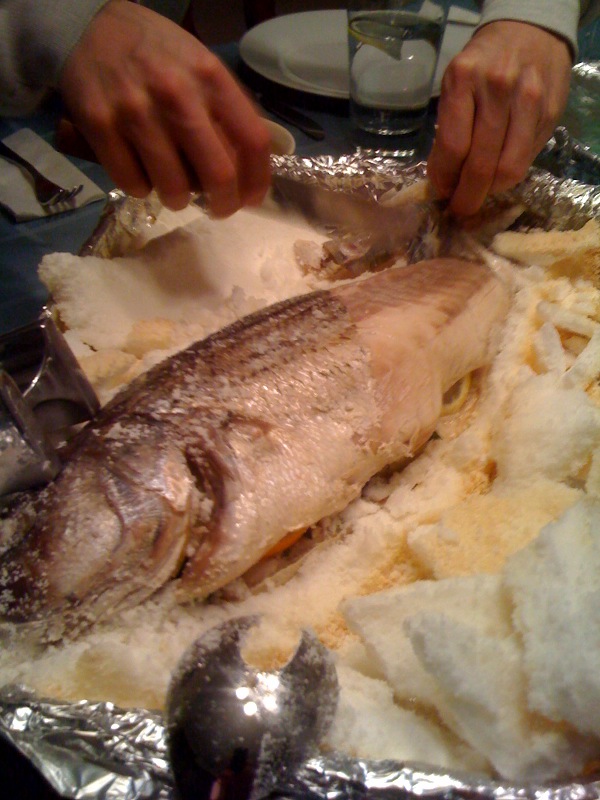
Herbina's beauty is more than skin-deep.
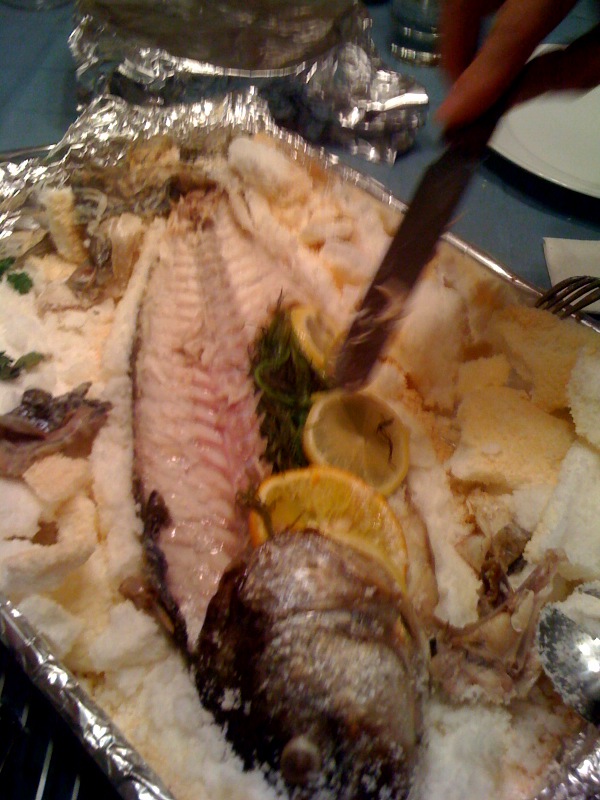
After you remove a fillet, remove the shrubbery.
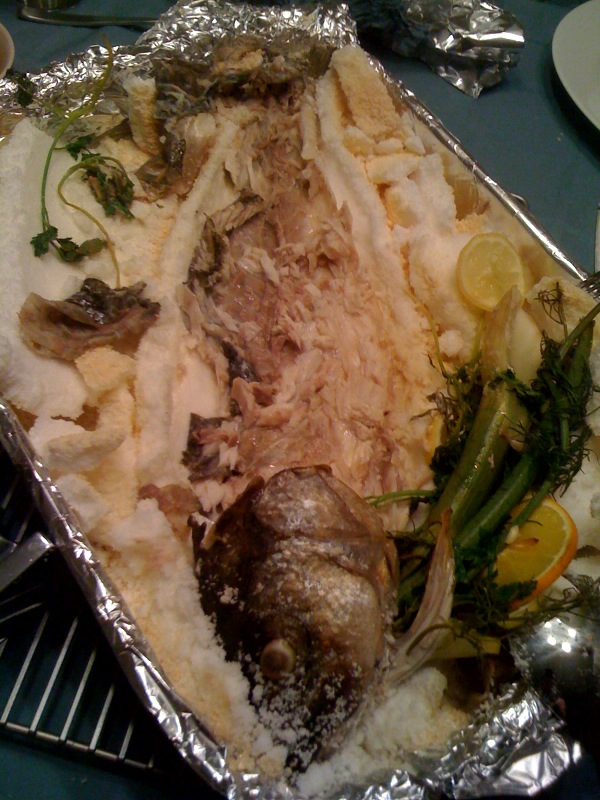
Yikes - Herbina's looking a little ... thin ...
Pasta with Wine-Marinated Short Rib Ragu
t says: Just the other day (over a year ago), g and I received a Williams Sonoma catalog in the mail. On the cover, there was the most beautiful piece of cookware I had ever seen. It was the “slate” Le Creuset Dutch oven. The color screamed chic and classic at the same time. The thing is … I didn’t really know how to “use” a dutch oven. Wasn’t it just a super-heavy pot – why would anyone want one of those? Perhaps it’s just a status symbol (like All-Clad and Viking)? Fast forward to June 2009 – my parents found out that I had perused Dutch ovens at one time and purchased for me a beautiful red Le Creuset for my bday. Trust me, I liked the red one a lot (I love the color red in general – I used to have a bright red pair of shoes and am on the lookout for a new pair of bright red shoes), but I was let down that slate was no longer available at WS (curse them and their “limited edition” colors). Interestingly, k and her then-fiance/now-husband, cm, showed us their recently acquired Dutch oven at that time – it was the SLATE one! Apparently, the WS they had visited happened to be clearing them out (thus, while online availability was nil, I guess some stores still had stock – but I couldn’t find any). Fiddlesticks – I knew that the search for slate was over (unless I wanted a tiny slate saucier, which was the only thing ever in stock) …
Because I was still a neophyte to the wonderful world of enameled cast iron, I decided to do some research (and looked for alternative colors and brands). I ended up browsing a line of cookware from Staub – the “other” French Dutch oven company with quite a following of devout anti-Le Creuset-ists (I kinda liked that). I was impressed with the black interior and self-basting “spikes” (although sometimes I wonder if this is a gimmick because Thomas Keller and Molly Stevens both recommend parchment paper to line the lids of their braising vessels), but when I saw that they were just releasing a new, limited edition “titanium gray” color, I knew it was made for me. I swapped the red Le Creuset for the titanium gray Staub (6.5 qt – it isn’t as classic as the slate, but, because it reminds me of a brand new dark gray bmw, it has more bling). I also immediately invested in a copy of All About Braising, as what is the purpose of having a piece of cookware but not knowing how to use it? Over the ensuing 6 months, I braised everything – chicken, beef, pork, vegetables, seafood (although the latter two required a smaller vessel – so I used our other cookware). The following is my favorite recipe thus far (probably because I <3 short ribs) and is adapted from recipes by Molly Stevens and Giada De Laurentiis, with a fine point or two from Thomas Keller. This dish has finally allowed me to see a short rib recipe on a restaurant menu and NOT automatically order it (I <3 short rib), as now I know I can make a respectable version at home (although definitely NOT fancy – very “rustic”).
Ingredients:
the spiced EtOH:
__ 1 bottle of tasty, inexpensive red wine (For this, I like something a little less “fruity” – not Australian Shiraz or Argentinian Malbec, rather, something a bit more rustic, like some Sangiovese-based Italian blend or dip into Spain. I personally don’t opt for Chianti because I’ve run into a lot of bad Chiantis until I started getting up into the Chianti Classico range at $20+ … which is WAY too much $$ for a recipe like this. In short, pick a red wine you want to drink that isn’t insanely fruity.)
__ 1 tsp black peppercorns
__ 0.5 tsp allspice berries (optional)
__ 4 whole cloves (optional)a few rosemary sprigs
__ 2 bay leaves, broken in half
__ 1 tsp kosher salt
__ Cheesecloth and kitchen string (optional)
the meat:
__ ~3.5 lbs of beef short ribs bone-in (not thinly sliced)
__ Kosher salt and pepper
__ <0.5 c olive/canola oil mix (olive oil adds nice flavor, but smokes a lot – canola oil is neutral, but has a much higher smoke point – so I go 50/50, but sane people can just use whatever oil they want! I hear grapeseed oil is good for frying, too!)
the braise:
__ 1 large onion (for this, I prefer sweet and yellow onions > white onions > red onions), diced
__ 4 cloves garlic, minced (I prefer fresh to jarred)
__ 5 roma/plum tomatoes, cut into large dice (or 4 if they seem exceptionally large, or 6 if you REALLY like tomato)
__ 2 Tbs Dijon mustard
__ <2 c beef stock (I used Kitchen Basics “Unsalted”)
the finish:
__ 0.75 lb pasta (medium-sized shape like penne, farfalle, or, my favorite, cellentani) – if using a small shape like elbows, use 1 lb
__ 1 small bag of frozen peas (you won’t use the whole bag)
__ some Italian parsley (optional)
__ Grated Parmigiano Reggiano and/or Pecorino Romano (I probably use ~0.3333333333 c of each, but I just buy a small block of each, and grate it as needed to taste/texture – feel free to use one or the other depending on which you prefer or is available)
Methods:
-1) To marinate or not to marinate? If you know you’re going to make the dish well in advance, you could marinate the beef the day before. Unfortunately, not everyone is able to do this. I’ll pretend that you don’t and then make recommendations afterwards if you do. So … if you are going to cook all of this in one day … Gently pour 1.5 cups of wine into a saucepan. Slowly turn up the heat until the wine just reaches a boil. Turn off the heat. When the wine stops bubbling, add peppercorns, allspice, cloves, rosemary, bay leaves, and 1 tsp kosher salt. Stir. Proceed to step 0 as the pot cools.
Words of wisdom re: Step -1:
a) If you have cheesecloth, you may instead bundle the herbs/spices into a satchel tied off with kitchen string, and add the satchel to the heated wine (like a tea bag). I have no cheesecloth, so I instead will just strain the herbs/spices after I’m done.
b) If you’re going to marinate your meat overnight, start with a larger volume of wine (~3 cups). Then, after the wine cools to room temperature, pour it into a high quality 1 gallon plastic bag (one you would bet your fridge on). Seal the bag with as little air as possible, place the bag into a large bowl (to prevent spills), and place the bowl into the fridge to cool for ~1 hour. Add the short ribs to the bagged wine and seal the bag with as little air as possible. Return the sealed bag-o-meat-and-wine to a safety bowl in the fridge. Marinate in refrigerator for 24-36 hours, turning at least once to ensure that all of the meat is submerged in wine at one point or another.
c) Any remaining wine will be useful to sip as you continue with the braise.
0) Brace yourself. Preheat oven to 315 degrees. Slowly heat Dutch oven or some other wide, lidded, oven-proof pot (mine is 28 cm in diameter – the smallest size capable of holding all of the ingredients for this recipe is ~5 quarts) on the stovetop to medium-high heat. Pour yourself a glass of wine and buckle up for some cooking! N.B. If you marinated the meat, remove the ribs from the marinade (ensuring no peppercorns, cloves, etc are stuck to the meat), pat the meat dry, and reserve 1 cup of the marinade (liquid-only – no herbs, spices, etc) – do NOT accidentally drink it.
1) Sear the meat. Season the short ribs with kosher salt and pepper. Next, add enough oil to the heated Dutch oven to just cover the bottom. Brown the ribs (in batches) in the Dutch oven on all sides until beautifully crusted; set aside all ribs. When you’re on your last side of your last batch of ribs, turn the heat down to medium-low.
2) Assemble the braising base. Add onions to the cooking vessel and keep them moving to avoid burning; cook until translucent. Add garlic and mix. As the garlic becomes fragrant (~30 seconds), add half of the tomatoes and them down until the tomatoes start getting softer. Add the rest of the tomatoes, and cook until all the tomatoes are soft. Add 1 cup of the spiced wine (i.e. reserved marinade) – there should be NO herbs/particles in it, as they’ll be a pain to remove later. Mix and scrape the bottom of the pan with a wooden/plastic/nylon spatula to release the “brown bits”. Cook until the new liquid (from the wine and tomatoes) reduces in half (a few minutes depending on how hot the vessel was). Add the mustard; mix to combine and cook until simmering again.
3) Bring on the meat. Nestle the ribs into the Dutch oven. Add beef broth until the total liquid in the pot reaches half-way up the ribs. Place lid on the vessel (if your lid doesn’t have re-basting spikes or is not completely flush, put a sheet of parchment paper between the lid and the vessel). Place into oven.
4) Set the temperature. Check on the vessel in 15 minutes. If the bubbling is any more than a “very light simmer”, reduce the heat by 10 degrees and check again in 15 minutes. Continue reducing heat in this manner until the desired bubbling is achieved. After 1 hour of cooking, flip the short ribs. Total cooking time will be ~3 hours or until the meat easily pulls away from the bone and is fork-tender (if you can’t poke a spoon through the meat, it’s not done yet). Enjoy that glass of wine while you wait …
5) Make the pasta sauce. Remove the ribs from the cooking liquid, and set aside under a foil tent. Let the cooking vessel sit for a few minutes, and, using a large spoon, remove any excess fat from the surface of the cooking liquid. Alternatively, a gravy separator would also be handy. Using a ladle, transfer the entirety of the remaining cooking liquid into the bowl of a food processor or blender. Process/blend until the mixture is smooth sauce. An alternative is to simply let the vessel cool, stick it in the fridge overnight, remove the congealed fat the next day with a spoon, and then sticking the vessel it straight back into the oven at a low temp just to re-heat it before proceeding to step 6. Meats braised like the short ribs in this recipe often benefit from a night in the fridge!
6) Make the pasta. Cook your pasta of choice as you perform step 7. Use a timer so you don’t accidentally overcook your pasta (step 7 is very distracting). Reserve 1 cup of the pasta cooking water when done.
7) Disassemble the meat. Remove the meat from the bones. Using 2 forks, shred the meat into smaller pieces. Some may also want to remove large pieces of fat as well – do as you please.
8) Ta-da! In a serving bowl, combine pasta, the sauce, and the meat. If the sauce needs to be thinned (which it hasn’t for me, ever), add some of the reserved pasta water (but be careful, because you might have salted the pasta water – and both of the cheeses could be salty). Add frozen peas until the desire pasta:pea ratio is reached. Add grated cheese(s) until the sauce takes on a creamy, cheesy texture and the desired taste. Season with salt and pepper if necessary (given these cheeses, you’ll likely not need much of the former). Add chopped parsley until desired parsley density is reached (adds a little vegetal zing to the dish … I find it unnecessary).

 after dinner sneeze