Archive for the ‘Hoofed’ Category
Revisiting Braised Cow …
t says: I was at a new super-Walmart-atron the other day. I was surprised to find that they had beef cheek! No one else (i.e. no normal run-of-the-mill grocery store) has beef cheek! And now it was mine … for less than $2 a pound! So I bought some …
What did I do with it? I braised it, of course. I used our short rib pasta recipe. It … was … awesome.
It took a bit over 3 hours to braise a mere 3 lbs. I did trim the beef cheek substantially cuz there’s a lot of big pockets of fat. I did, however, save one huge piece of fat and stuck it into the Dutch oven to braise with the meats so it could add some luscious sweet deliciosity. The result was a wonderful pasta dish. Mmmmm.
It didn’t taste as gamey as a short rib or an oxtail – and the texture was even more tender, so I imagine I’ll continue to use it in the future (without telling anyone it’s “beef cheek” – that name might turn some people off). It’s also cheaper than the other two – even if you consider that approximately 1/4-1/3 of what you get is fat that gets trimmed …
Rock on beef cheek …
Pork Shoulder Sandwich and Kimchi Jigae (with pix)
t says: We once tried to make a pork shoulder, but it didn’t turn out right. We tried to braise the sucker, but the meat just ended up being too tough for my taste (which we tried to hide by shredding the bejesus out of it). The thing is, from the beginning, kp told us to forego braising and just roast it: put on the rub, stick it in the oven, and let it go at a ridiculously low heat for a long amount of time. I doubted whether this would actually work because that’s how my grandmom used to make her Thanksgiving turkeys, and although they were made with love, they were just a bit dry.
Well, flash forward a few months … I had the hankering to cook a large piece of meat this past weekend. Why large? Well, I wanted to cook something large in volume that I could slowly eat over a few days – I foresaw that I would have little time to cook. Then I remembered how whenever I go to the Wegman’s meat section, I always end up staring at the pork shoulder. It was my white whale. I’d curse silently under my breath, “why??? but I did everything right!”. Of course, there’s no real reason for me to hold a grudge against the pork, as at $1.30 per pound, what was preventing me from giving it another whirl? The more I thought about it, I realized that I basically owed it to myself to try it again – the meat was so cheap it might as well have been free!
But how would I make it this time? The braise last time was a disaster. I needed a change-up. So I opened up David Chang’s Momofuku Cookbook. He had a recipe for pork shoulder that he uses for his ramen. It was simple, straightforward, no frills … and it was precisely what kp said: put on the rub, stick it in the oven, and go. So it was settled. I was going to roast the pork and make sandwiches out of it. But one cannot live on pork and bread alone! (Ok, scratch that – one can live on pork and bread alone, but not even kp would consider this a healthy diet). I figured that pork is savory and salty, so I wanted some sour and spice to punch it up, some vegetable to keep my doctor happy, and some cheese to both quell the spice and add some mouth-coating texture (aside from straight-up pork fat from the meat). What I eventually decided on was an homage to the South, Korea, and Italy … and pigs.
Ingredients:
__ 4.5 lb pork shoulder (but any size will do – David Chang claims that it won’t change how long you cook the thing for – I don’t know about that, but what the hell do I know?)
__ Sugar
__ Kosher salt
__ Dr. P-I-M-P’s ‘Bama Backyard BBQ Rub <if you can get some>
__ Some wilted spinach (olive oil, salt, pepper, garlic, crushed red pepper, toasted sesame seeds <optional>)
__ Some ggakdugi
__ Some Parmigiano Reggiano cheese
__ Some sesame-studded sandwich rolls
-2) Let me explain some things here:
A) What the crap is Dr. P-I-M-P’s ‘Bama Backyard BBQ Rub? It’s a secret concoction of herbs and spices that only kp can make. Actually, I’m not even sure he has it written down, as then it might fall into the wrong hands. The only way to get your hands on some is to send us an email and pray that kp will be able to whip you up a batch. Alternatively, you could try mixing your own blend of seasonings (chili, garlic powder, paprika, cumin, etc) – but in actuality, David Chang uses straight up salt-sugar in 1:1, so don’t fret if you can’t get any of Dr. P-I-M-P’s rub. But I will say that I suspect that David Chang uses a far coarser Kosher salt than Morton’s, so stick with 0.5:1 salt:sugar. The sugar makes getting a nice crust easy.
B) WHY ARE THERE NO AMOUNTS? Because everything will change based on how big a shoulder you get. To give you a ballpark, for our 4.5 lb piece, we used less than 1 cup total of the sugar-salt-rub combo. As for the spinach, ggakdugi, cheese, and rolls, how much you need will be based on the proportions you use to build your sandwich – just make it up as you go!
C) About that wilted spinach … Take some [very-meticulously-washed] spinach, put it in frying pan with some olive oil, salt, pepper, and red hot pepper flakes, and apply medium heat. When the spinach just starts to wilt, turn off heat, add the sesame seeds (if you have them), and keep tossing/turning the spinach. The very moment before the moment before (not a typo) all of the spinach reaches complete doneness, remove it from the warm pan and put it on a cool plate, leaves spread apart so it’ll stop cooking faster.
D) What the crap is ggakdugi? It’s radishes that have been mixed/pickled with/in a red hot chili solution. There’s no way I’d ever make it, myself (it’s an involved process that makes your hands reek for days), but it can be found at a lot of Asian/Korean grocery stores. Kimchi could also do the trick. If you’re afraid of the old Asian people at the market, just bring along one of your Asian friends and you’ll be ok …
-1) The night before you want to roast the pork, mix up the salt, sugar, and spiced rub in a 0.5:1:1 ratio. Rub down your shoulder in it. Stick it in the fridge, covered, for 4-24 hours. Apparently, if you go for more than 24 hours, the pork is too salty – I have no idea if this is true.
0) On the day you want to start roasting (i.e. 6.5 hours from when you want to begin eating), preheat your oven to 250 degrees.
1) Remove the shoulder from the fridge and place on an oven proof tray – something with sides to catch all the fatty goodness.
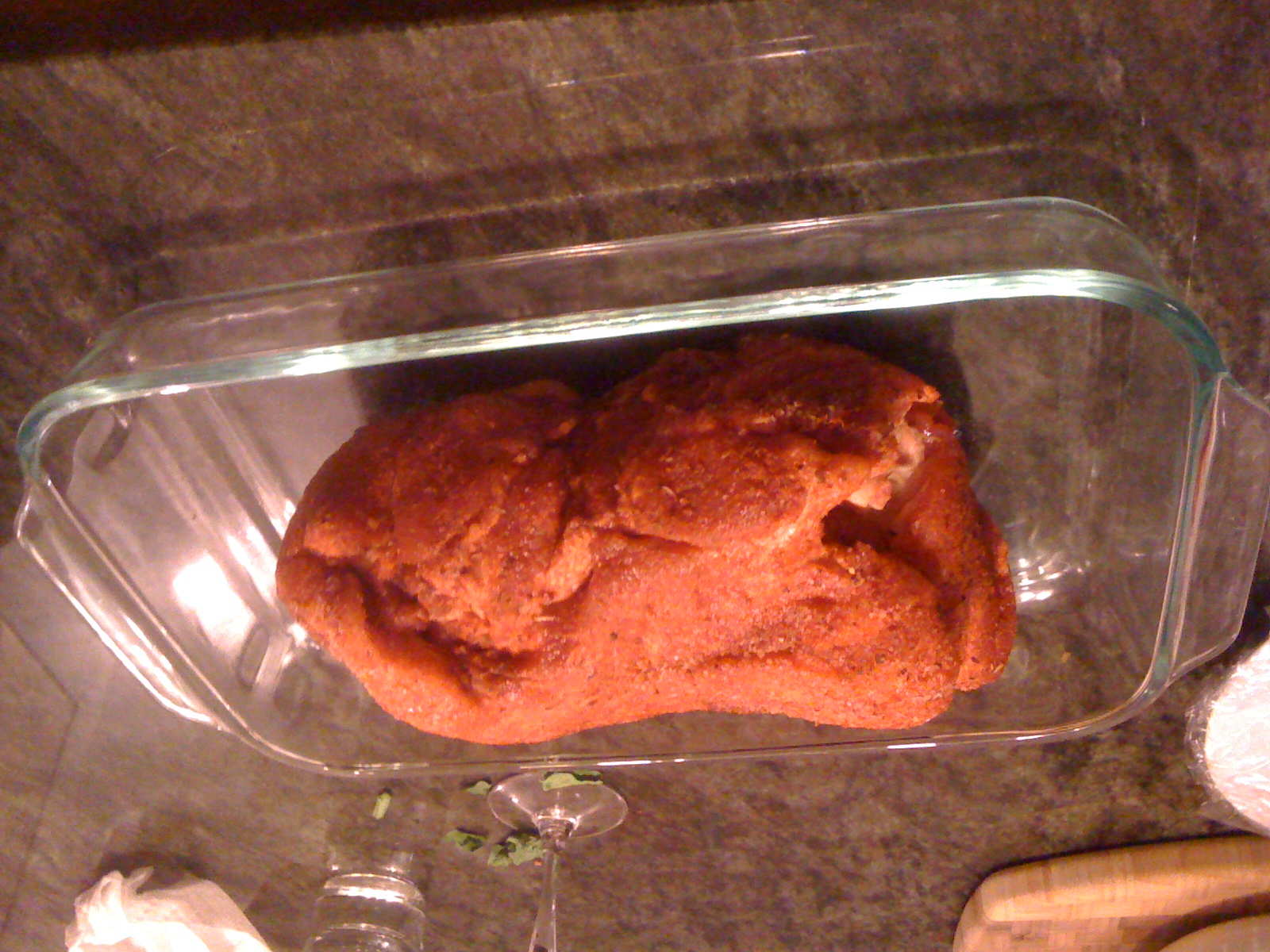
2) Stick it in the oven. Amuse yourself for 6 hours, taking breaks from your amusement every hour or so to baste the pork in whatever juices have fallen out of it (there won’t be much the first hour or two). I also like to rotate the pan in the oven in case there are any hot/cold spots. Bittman recommends flipping the shoulder over every hour – I forgot – but I’d totally do it next time; just be careful not to squeeze it too hard or you might ring the juices out of it. If you really want, at the one hour mark, pour about a half cup of some kind of aromatic liquid onto the pork (e.g. stock, wine, beer) – it smells nice and gives the shoulder a head start on having some liquid to baste with at the 2 hour mark.
3) Remove the pork from the oven after 6 hours of roasting. Let the pig rest for a half hour, covered with foil. Do NOT cut it. Do NOT prod it. Do NOT test its temperature. If you have faith in your oven reading 250 degrees, then after 6 hours, trust me, it’s fully cooked. Here’s a sneak peek under the foil …

And after it rested, I cut into it …

4) Slice off beautiful pieces and assemble sandwich. Here’s some inspiration:
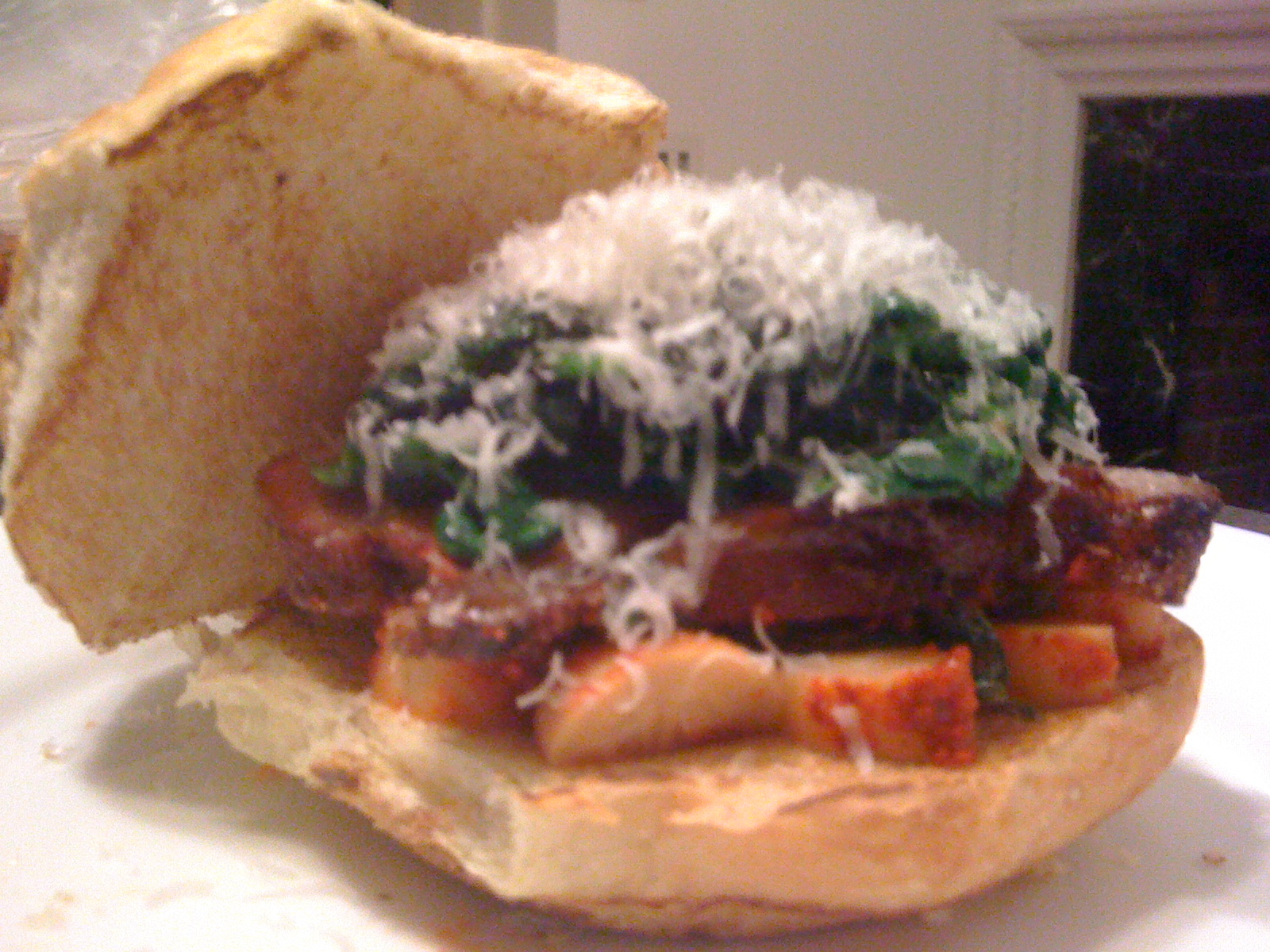
Bottom to top: bread, ggakdugi, sliced pork, spinach, cheese
5) Leftover pork shoulder can be shredded and refrigerated (don’t forget to add some pan juices – but don’t add too much as there’s a lot of fat and salt in there) to be enjoyed over the next few days in more sandwiches, pastas, eggs, rice, etc. Either reheat it in the oven back to 250-300 degrees or try the microwave (but be careful with the microwave – if it gets too hot, then your pork will be tough!).
6) If you really want to be a Korean bawler (i.e. if you want to make your apartment smell really REALLY bad), take your shredded pork (but don’t shred it too finely – you still want something to bite into) and add it to a pot with some kimchi and a little bit of water, ginger, soy sauce (only a little! the pork is salty as it is!), and some extra firm tofu. Heat on low for a half hour or so (or at least until all of the components are heated through completely – you’re not trying to “cook” anything), stirring occasionally. This is a quick-and-dirty version of kimchi jigae – it’s spicy and stinky, but man is it tasty. And yes, it seriously smells very potent while cooking, so if you have a grill or something, cook it outside.
Oxtail Chili (and Pasta Sauce) (with pics)
t says: g makes a mean chili. She even puts up with my absurd moods when she makes chili, including my desire to minimize ground beef consumption. g often took it one direction and went for a ground turkey and shrimp chili with lots of veggies – it was a lighter, “fitter” chili that tasted very good. But then, one day, I decided that I wanted to bring back the beef … without using ground beef. I wanted chunks of beef! But it’d be weird to just cook up a steak and add it to chili. Plus, when we make chili, we make a whole mess of it and eat it for a couple of meals, so the beef chunks would have to withstand a trip to the fridge and a few minutes in the microwave. I don’t know what your experience is, but steaks in my hands never do well in the microwave. So … chunks of beef that need to stay tender? Time to whip out one of my favorite pieces of cookware … the Dutch oven!
But which piece of meat to braise? I already had a recipe using short rib, so that was out. And I kind of wanted something manlier for a chili – I wanted the kind of meat that would put hair on your chest. I turned to oxtail. That’s right – oxtail – it even sounds manly! It also has a nice strong beef flavor that won’t be easily lost in our mish-mash that we call chili. Actually, when we first made it, we braised the oxtail and then used both the meat and the braising liquid as the foundation for our chili. Yikes! The oxtail easily overpowered everything else in the chili! That was not so great because we actually wanted to taste vegetables or other meats (i.e. we tried shrimp and oxtail … yea … the shrimp didn’t stand a chance). So what I now do is braise the oxtail and then use the meat for one dish (i.e. chili) and the braising liquid for another (i.e. pasta sauce, aka “gravy”). Now, g and her mom both make some pretty mean gravies – there’s no way I can compete with theirs. This is more like a Korean’s attempt at making gravy, so I’m calling it “pasta sauce”.
Note that one could actually braise the meat one day (thus producing the pasta sauce) and then reserve the meat to complete the chili the next day. Alternatively, one could just braise the oxtail and combine the meat and braising liquid to make a REALLY meaty pasta sauce, unlike my recent experience at Melograno. Or you could just make it all a chili. To each his/her own.
Note that this chili would be disqualified from an actual chili competition due to our use of beans and “filler” (i.e. rice), but we’re still gonna call it chili … in your face International Chili Society. Also – we are not spice connoisseurs – so pardon our paltry collection of supermarket spices and feel free to use whatever spices you like to put in chili – we just use what we have. Finally, we do used canned corn and beans for convenience, however, if you have the time/patience, soak some dried beans [for several hours] and roast some corn-on-the-cob – it tastes better and is healthier!
Ingredients:
For the gravy (makes enough for 0.75 lbs of pasta)
1 package (2-3 lbs) of oxtail (short rib probably works, too)
1 can (~28 oz) crushed tomatoes (Tuttoroso is best, Wegman’s is satisfactory, Hunt’s is abysmal)
3 big (or 4 small) cloves of garlic, freshly finely minced
50% of 1 large onion, diced
0.75 cup alcohol (red wine is nice, but I’ve used vodka, vermouth, white wine …)
leftover rind from slab of parmigiana reggiano cheese (or you could just use a half-cup of cheese)
salt, pepper
0.25 tsp baking soda
<0.5 c canola oil
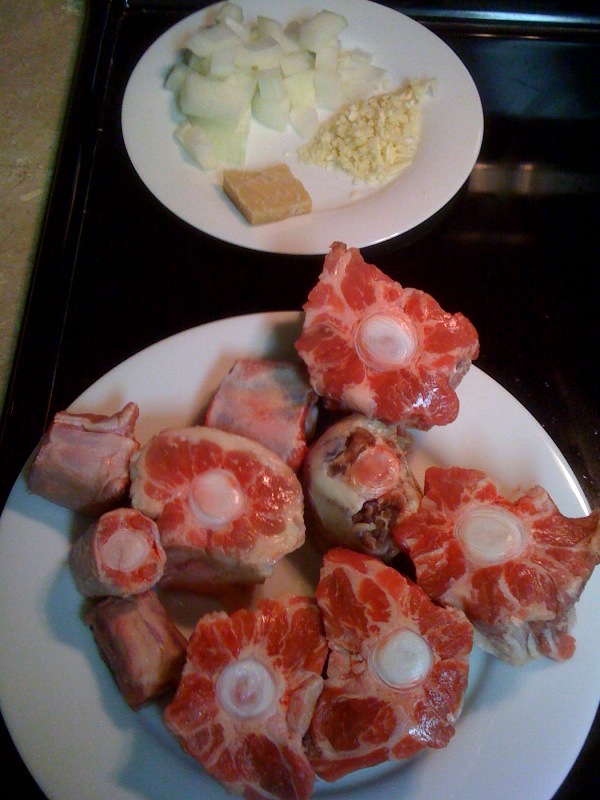
Mis-en-place in place.
For the chili
0.75-1 lb Italian pork sausage, casings removed
1 cans (28 oz ea.) crushed tomatoes
1 can corn, liquid removed
1 can black beans, liquid removed
1 can kidney beans, liquid removed
<1 pint of leftover white rice from the fridge (like “small” size you get at Chinese takeout)
1 jalapeno pepper
50% of 1 large onion, diced
1 green bell pepper, “diced” (are you allowed to call it “diced” if the resultant pieces are not cubes?)
1 red bell pepper, “diced”
Shredded cheese (cheddar, monterey jack, whatever)
Seasoning: salt, pepper, cumin, “chili” powder, cayenne pepper, garlic powder, crushed red pepper, srirarcha
Bread: optional
Methods:
0) Remove oxtails from fridge and allow to come to room temp as you cut your vegetables. Preheat oven to 315 degrees. Put Dutch oven on stovetop, and slowly turn up the heat to medium-high.
1) When the Dutch oven is ready, season oxtails with salt and pepper. Add oil to the bottom of the Dutch oven – use just enough to so that an even pool just covers the entire bottom. Sear the oxtails (in batches) until nice and brown on all sides. Set aside. As you sear the last side of the last batch of oxtail, turn the heat down to medium-low.
2) Add 50% of the onion (i.e. all that is designated for the gravy) to the Dutch oven and cook until the onions get a little color and become translucent. Add the garlic, and cook until fragrant (but you don’t want the garlic to burn).
3) Add the alcohol and scrape the bottom of the Dutch oven to release those brown bits. As you do so, turn down the heat to low. Cook until the liquid reduces by half. Add half of the can of tomatoes and mix. Add the cheese. Nestle the oxtail and drippings into the pot. Continue adding crushed tomatoes (including some on top of the oxtail) until the liquid reaches half-way up the oxtails. Heat until the liquid just starts bubbling.
4) Cover Dutch oven with lid and place vessel into oven. Check in 20 minutes. If bubbling too vigorously or not at all, reduce or increase the heat by 10 degrees and check again in 20 minutes and repeat until playfully (not vigorously) simmering. Cook for ~3 hours, or until the meat is fork-tender and starts to pull away from the bone, flipping hourly. You know you’re there if as you try to flip the tails, the meat just separates from the bone without much provocation. Don’t worry if during the first 2 hours that the meat seems extremely tough – it’ll get there – I promise.
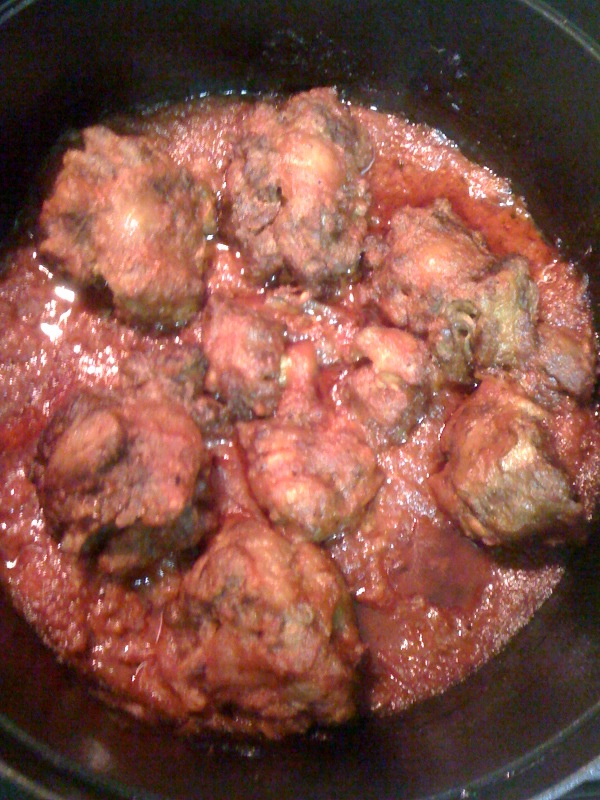
The braise goes on ...
5) Remove Dutch oven from the oven and let it rest, uncovered for 10 minutes. Remove oxtail and rest it aside in a foil-tented bowl for 20 minutes or until cool enough so that if it touches your finger, you won’t suffer 3rd degree burns. When ready, shred the oxtail into chunks using two forks – it’ll peel away from the bone quite easily. I tend to also look out for excessive cartilage/fat and remove them the best I can. Now, it’s decision time for the meat. Option A: You could save it in the fridge until the next day to complete the recipe. When you take it out of the fridge, the meat will appear very stiff and tough – but it’ll relax and be tender as soon as you heat it – don’t worry! Option B: You could use it in a chili right now!

Shreds in the bowl, bones on the plate.
6) Siphon off the majority of the fat from the braising liquid (or spoon it off or soak it up using a paper towel). Remove the cheese rind if that’s what you used. Add the baking soda and mix. VOILA! You have braising liquid! The decision what to do with it is yours. Option 1: you could just add the oxtail to the gravy right now and have a full-on meat sauce or a hearty chili, but what’s the fun in that? I feel that the gravy will tasty meaty enough without the meat – save the meat for the chili! Option D: you could reserve the braising liquid to serve as a gravy on its own. I like to put the sauce it in the freezer for later use. To thaw frozen sauce, I stick it into a pot under medium-low heat, add a little bit of water just to cover the bottom – this prevents the sauce from burning as it defrosts. When the block of gravy has melted, taste it and see if it needs more cheese. Add your favorite [cooked] pasta shape and enjoy! Now … back to the chili …
7) After removing the braising liquid, wipe down the interior of the Dutch oven – you don’t have to be fastidious – you just don’t want the stuck-on sauce to burn. Heat slowly to medium-high.
8) Put 1 Tbsp canola oil into the Dutch oven. Add the sausage. If you need, you can brown the ground meat in batches – you want to avoid overcrowding, otherwise you’ll be boiling/steaming the meat, not browning it. Set meat aside.
9) Cook onions in the sausage fat in the Dutch oven until onions take on some color and become tender and translucent. Add the peppers and cook only until they just start getting tender (i.e. cook them only half way to where you would cook them if you were going to enjoy a pepper sandwich). Add the second can of crushed tomatoes. Add corn and beans. Add the rice (the way we make it, we don’t like the rice to outnumber the beans, so we use 2-3 spoonfuls total – but add as much as you want!). Bring the chili back to a bubble. Add the meats!
10) In a separate ungreased pan at medium-high heat, roast the jalapeno directly on the pan until soft and black in spots. Cool, then pull the stems from the chiles. Cut into pieces (removing remaining seeds). Add as much of the jalapano as you want to the Dutch oven.
11) Time for the fun – seasoning with all of those powders we mentioned. This is really done to taste. I’d start off with 0.5-1 tsp of each and then fixing from there. Just be patient, mix thoroughly, and enjoy the fun of tasting it!
12) Serve up some chili and sprinkle on some cheese. Enjoy with bread!
Bacon Bacon Bacon!
t says: This past weekend, g said, “I want some mac and cheese.” A quick trip to google led me to Ina Garten’s recipe. I was psyched to use bacon – but the same ‘ol “problem” came up: the recipe called for far less bacon than one can purchase in a package at the supermarket. So what should I do with the rest? I made it my mission to use the entirety of the bacon to complete the meal. This is what I did …
Step 1 was to cook nearly all of the bacon (I’m saving some for some eggs this weekend) in the oven as per Ina’s recipe.
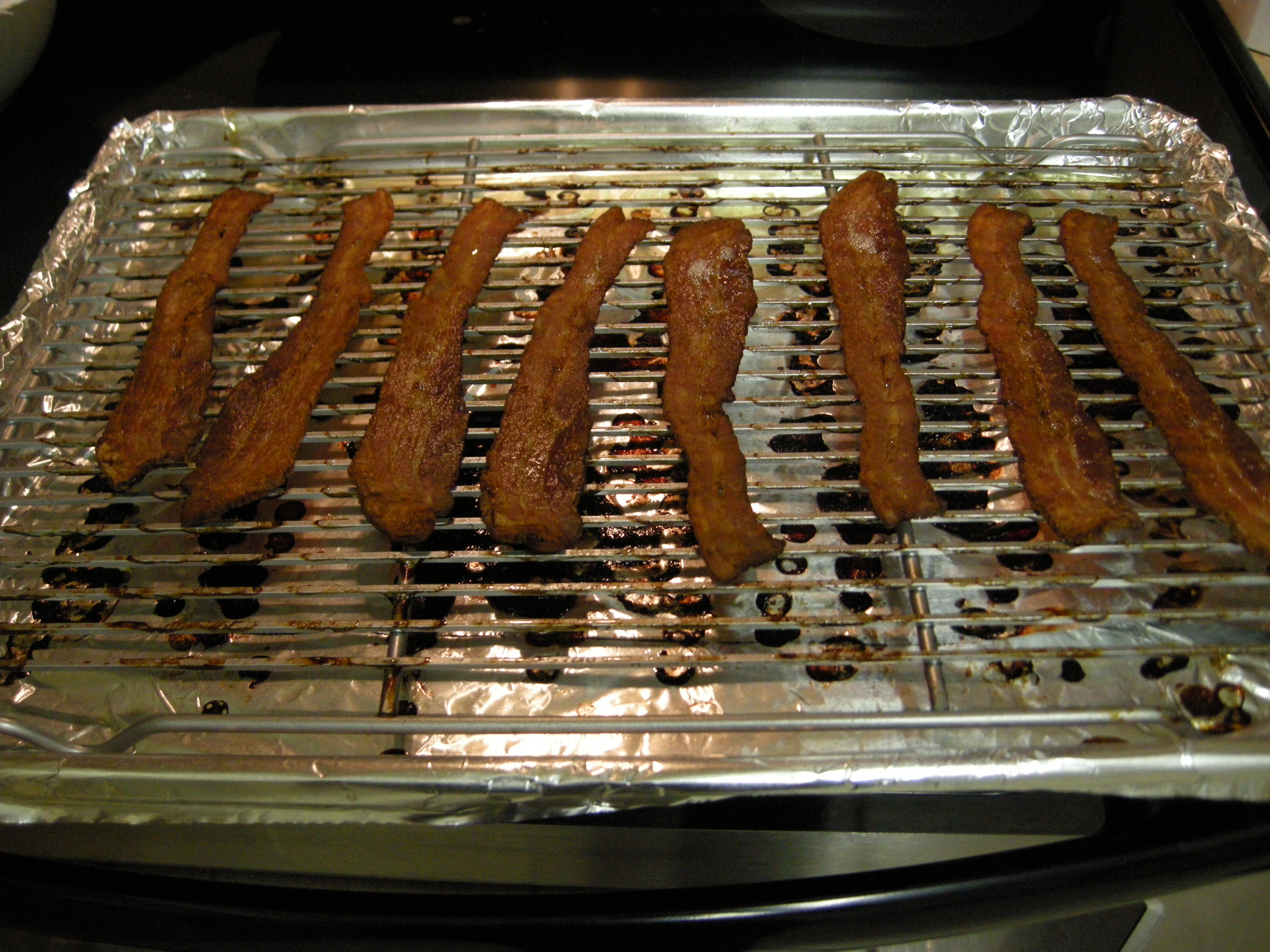
9 went into the oven - only 8 made it to the picture ...
3 of the strips of the bacon would serve as the 4-oz required by Ina’s recipe (which I also modified a little – upped the cheddar by an ounce and lowered the blue cheese by an ounce – a good thing, too cuz that blue cheese I got was kickin’ – g thinks it still has too much oomph!).
What next? Well, I figured that I needed a side dish. But what could I make that incorporates bacon? As I sat there looking at the dirtied pan, something shiny caught my eye … I knew what I had to do …
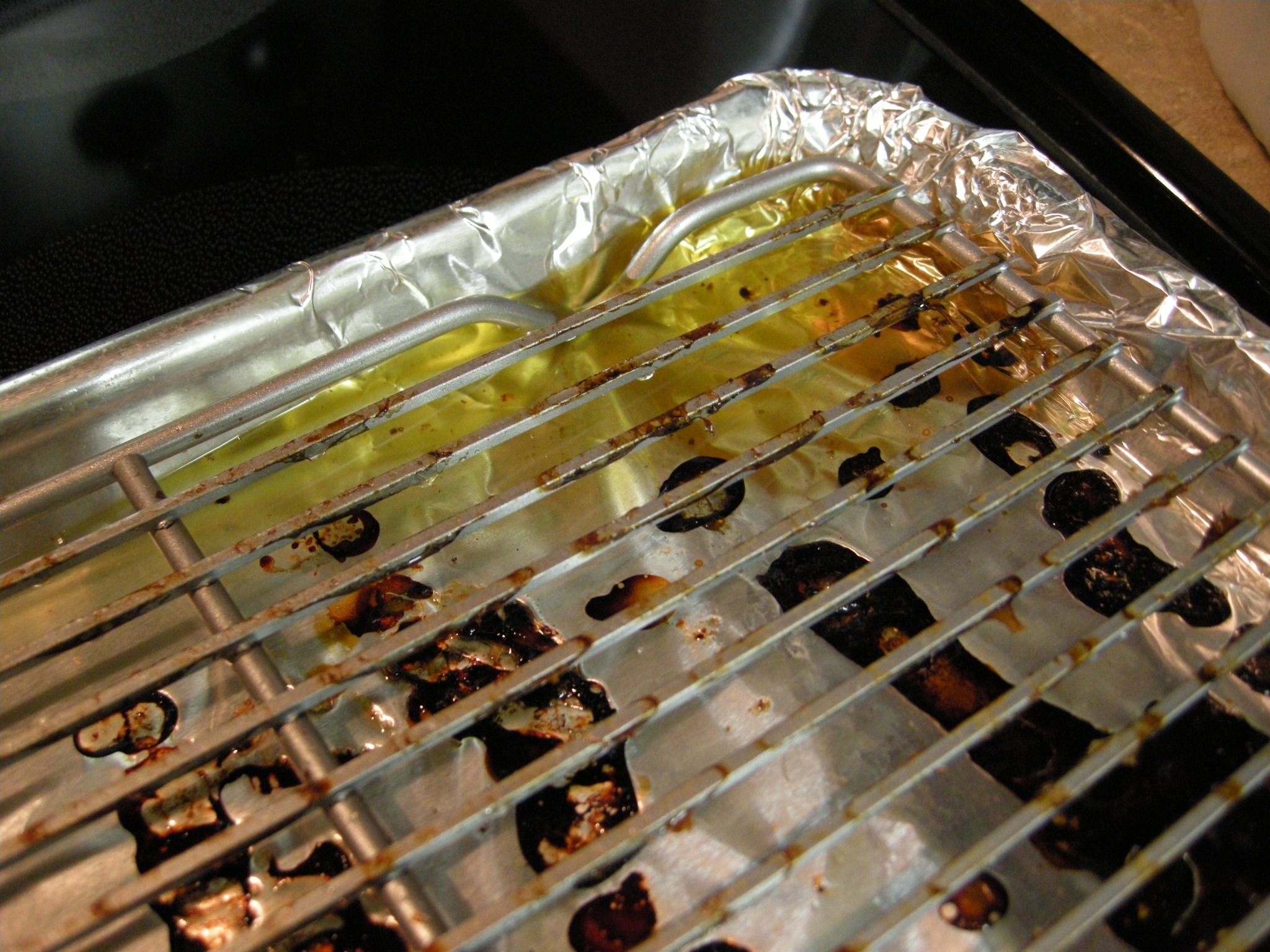
The grease says: "Don't forget about me!"
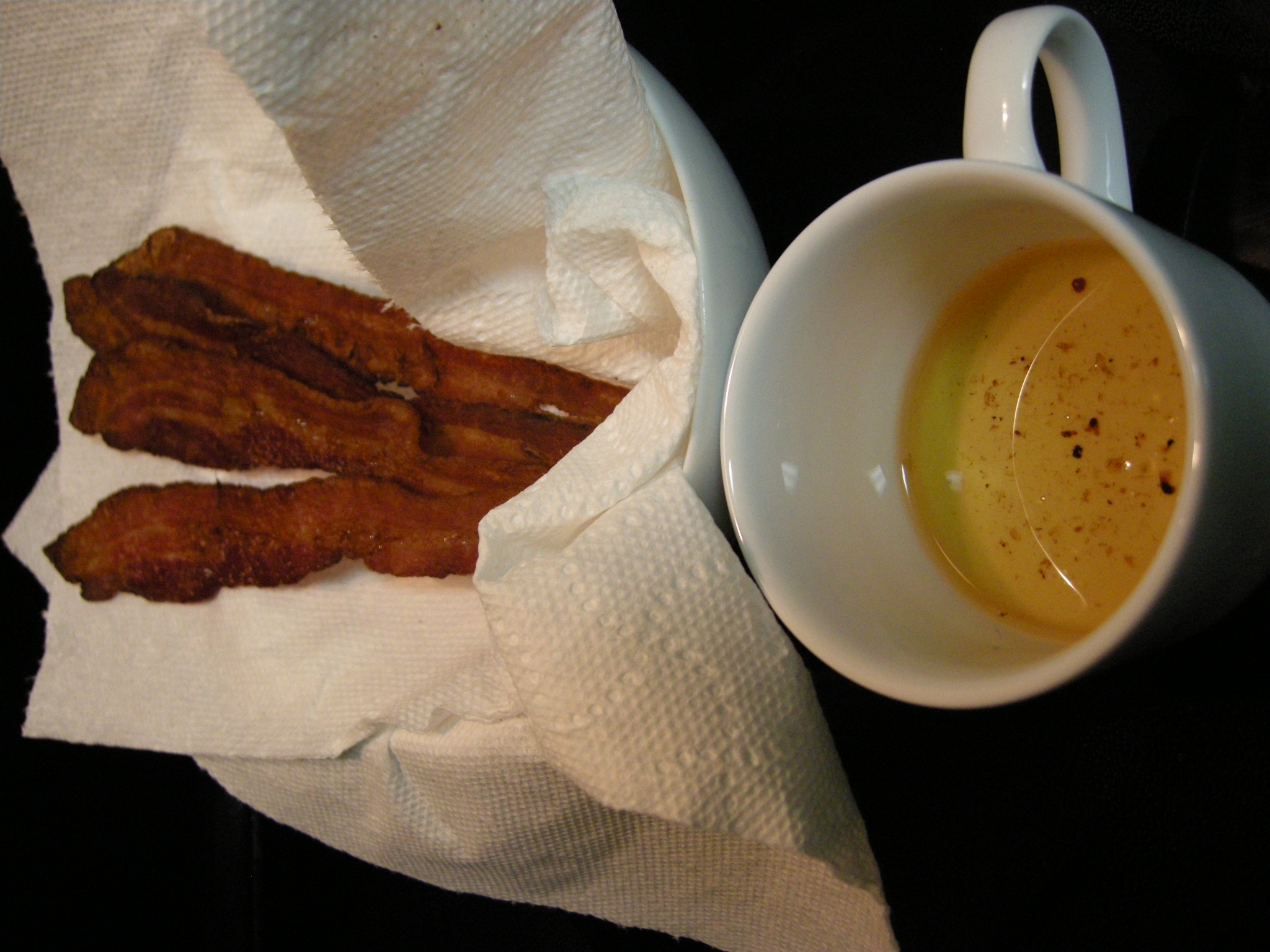
Through some crafty aluminum foil bending, I reserved the liquid gold ...
Inspired by Tyler Florence’s “Bacon-Braised Brussels Sprouts” that I must have seen 57 times around the holidays, I used the bacon grease to coat some halved Brussels sprouts, which I then seasoned with salt, pepper, Cayenne powder, and garlic powder before roasting in the oven at 400 degrees (turning every 5-10 mins). The end result was one appetizer and one side.
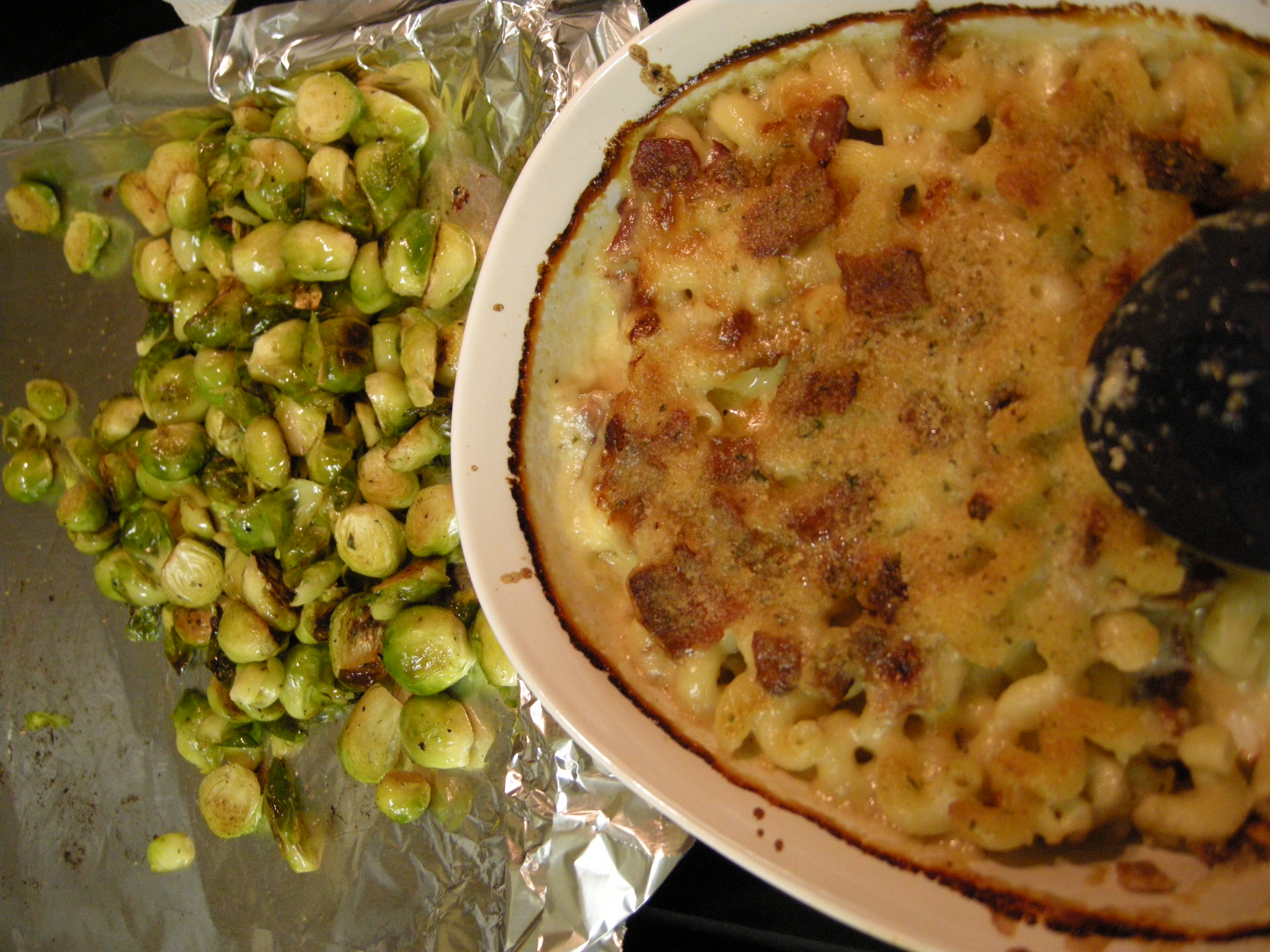
Main and Side ... both with bacon!
I didn’t originally intend to use bacon grease for the Brussels sprouts, but when I realized I used the last of the oil in the house for our eggplant parmigiana-lasagna, I had little choice. I must admit that I was a little disappointed with the color of the Brussels sprouts – I got a bad bunch so I had to prune way a lot of the dark green outer leaves – so what I used looked a little pale. They were also kind of small – so they were tender before their leaves got nice and brown – I guess a frying pan would have given me the char that I wanted, but I didn’t want to deal with high heat frying tonight – I was having a lazy day).
Ok, so you probably see where this is going … I have several strips of cooked bacon … and a need for dessert … I had the perfect solution …
A while ago, a friend of mine and I attempted bacon-chocolate-chip cookies. They were phenomenal – but quite annoying to make (you had to make the bacon ahead of time and incorporate it into the dough). I wanted to do something similar, but all of my cookie dough was already made and sitting ready-to-go in the freezer; incorporating bacon pieces wouldn’t be easy. The solution? Well – one time at Talula’s Table, a component in the dish called “Asparagus, Asparagus, Asparagus” featured bacon “powder” (which was genius). And there I had it – I’d dust the cookies with some bacon powder (or very tiny bits – I didn’t want to bring out a food processor to actually get a powder).
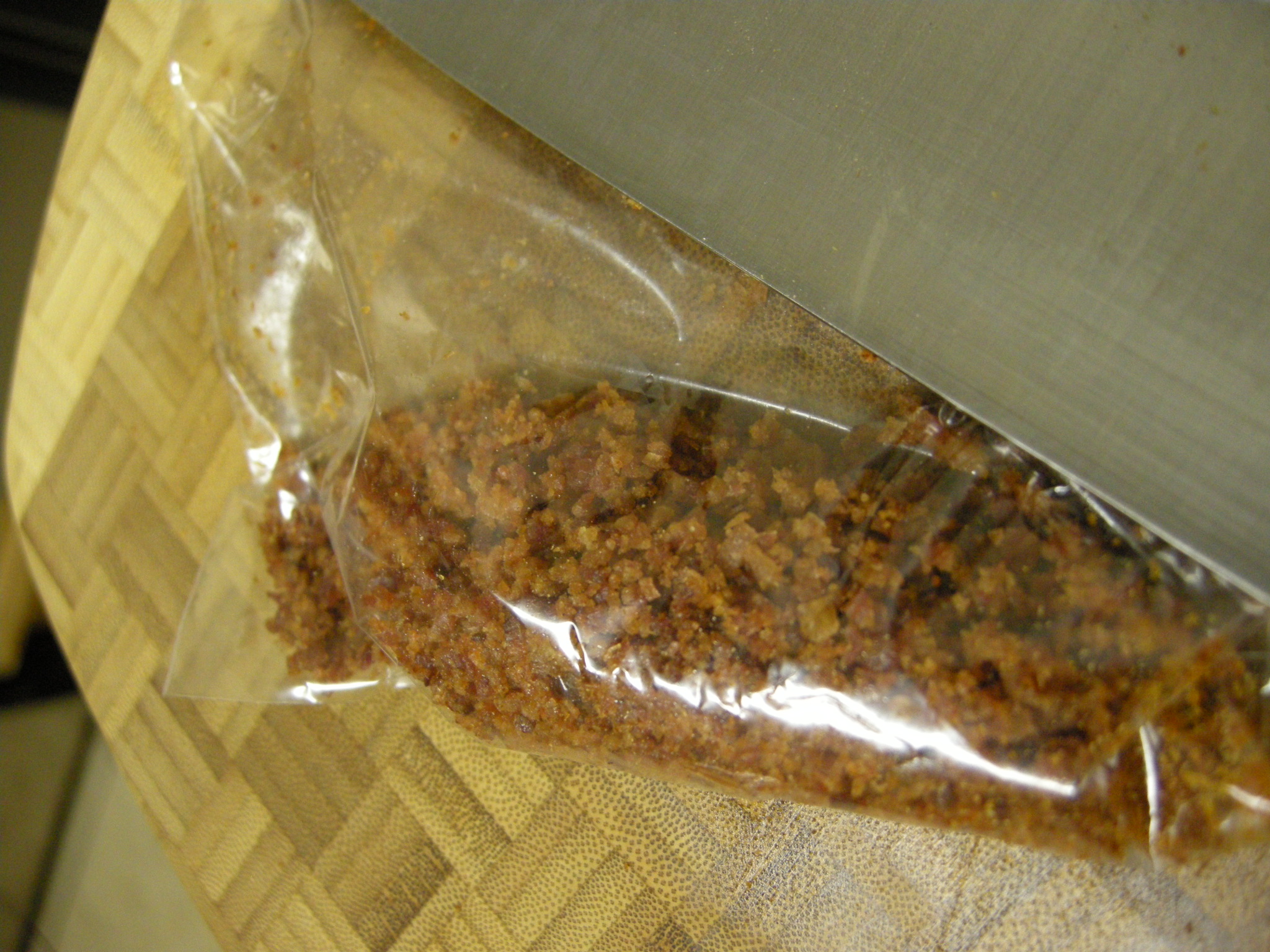
Bacon bits in a baggie - ready for cookies!
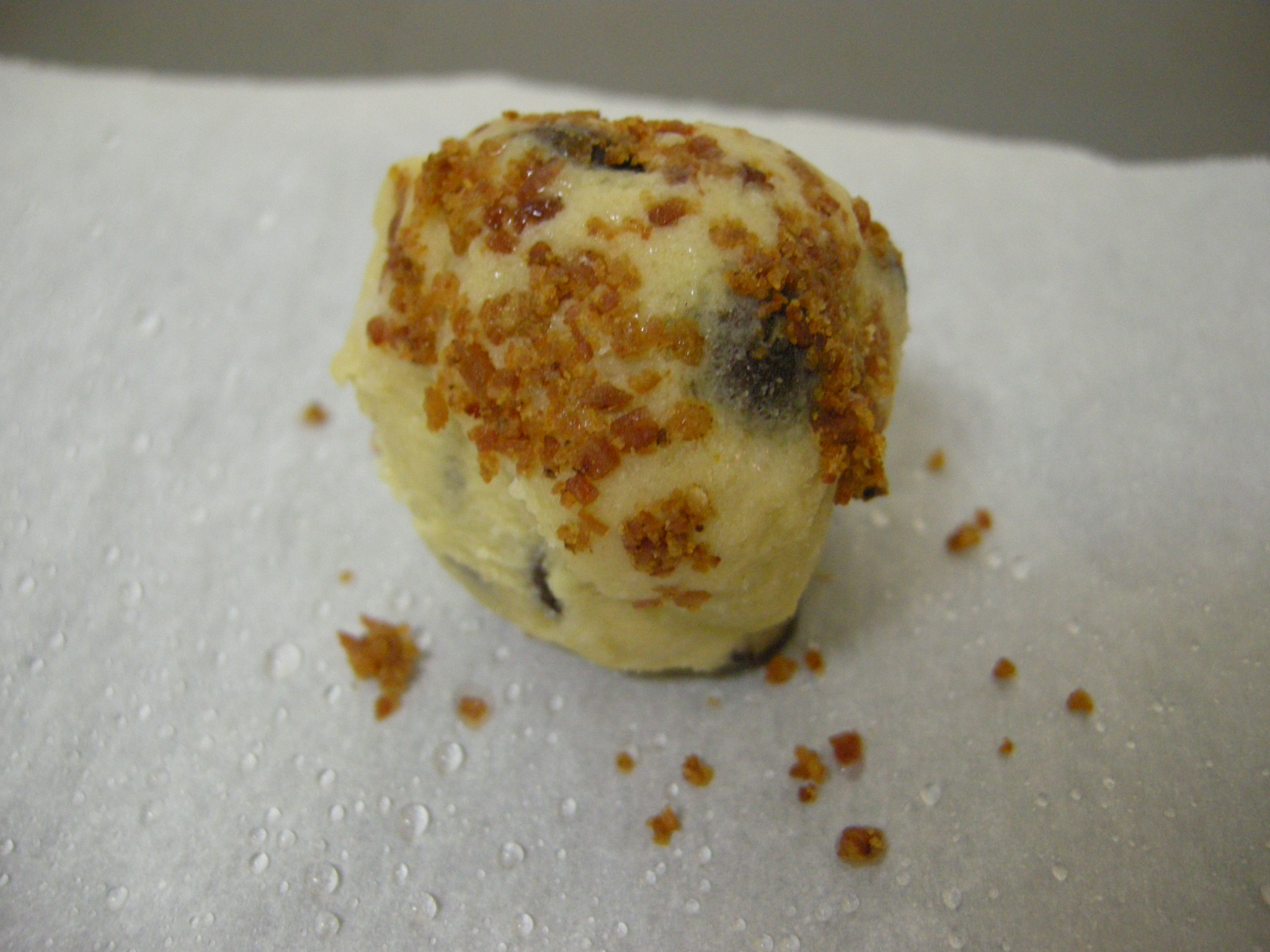
Pig and chocolate - before the oven ...
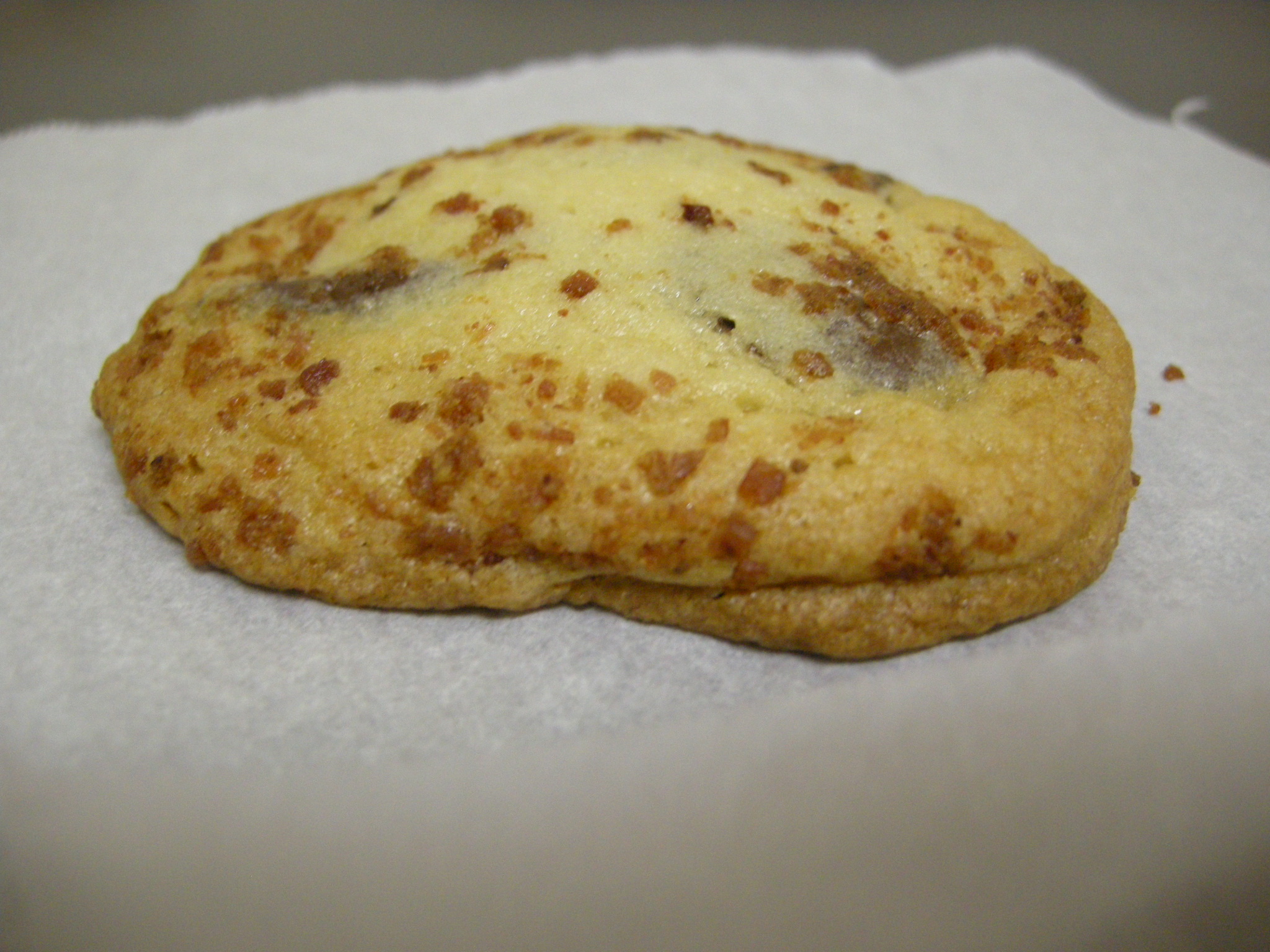
Savory and sweet, in one luscious package ...
Ta-dah!
So, I obviously still have bacon bits left over, but I’m going to rim the drink of a margarita glass like I saw on Iron Chef America recently. Can’t wait to see how that’ll taste (I’m hoping for a melon-based mixed drink so it’s like prosciutto-wrapped melon).
And … there we go! Three courses and a drink incorporating bacon! I must confess that I didn’t make the cookies the same night as the sprouts and the mac-n-cheese – I was just too full! But I could have! And isn’t that what really matters?
Oh … and a complete freak coincidence … a day or so after I thought of dusting my cookies with bacon (and didn’t tell anyone!) – look what lc sent us in the mail:
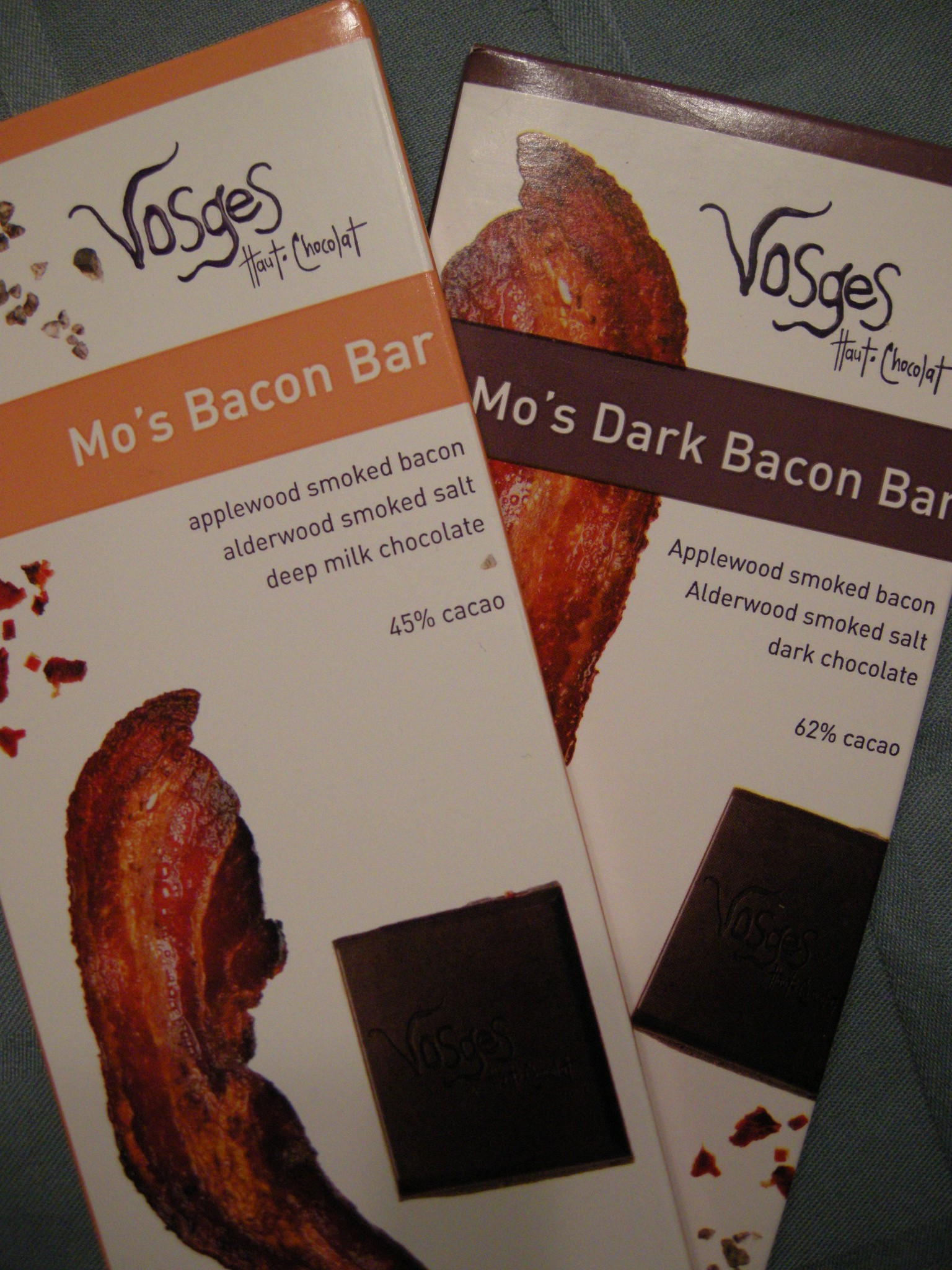
Pig and chocolate ... in bar form!
Can’t wait to try it!
Eggplant Parmigiana-Lasagna
t says: This weekend, like every weekend, I wanted to make something that would last us a few meals. I had a hankering for eggplant parmigiana, but I find that I get tired of eggplant parm really quickly. For me, there’s just too much eggplant flavor so that I’m usually eggplanted out by the end of my meal – who knows how I’d feel by the third time I’ve had it in the same week! Also, the texture of plain ol’ eggplant also gets boring when it’s reheated (you lose the crunch of the breading). But I got to thinking – what if I jazz it up with some meat? And use some different cheeses? And some pasta? It didn’t take me long to realize that I was no longer playing around with an eggplant parm recipe, rather, adding eggplant to a lasagna recipe! There we have it – a lasagna and eggplant parm hybrid! The recipe that follows is the love-child of Alton Brown’s eggplant parm recipe and Ina Garten’s turkey lasagna recipe.
When all the cooking was done, I think it was pretty good, and it’s definitely something I’ll make again. This is NOT a very gravy-full recipe – if you like tomato sauce, you can up the quantity. It’s also NOT a big puddle of oozy cheese. Everything is balanced (in my opinion), so I don’t think I’m going to make straight-up eggplant parm anymore (this way is just more fun). Don’t be intimidated by the number of ingredients or steps – it can be made easier by using oven-ready pastas or ready-made gravy (although the latter is sometimes a little yuck – but Barilla makes some decent sauces)! You could also omit the meat (but what’s the fun in that?), or swap out the veal for more turkey if you’re not a fan of red meat. g had the idea to add a layer or two of sauteed spinach … but I forgot … oops! In any case – you get the idea – it’s a pretty versatile recipe. You don’t even have to use this one – but try adding eggplant parm to your favorite lasagna recipe and see what happens!
Ingredients:
for the eggplant …
1 eggplant
all-purpose flour, panko bread crumbs, Progresso “Italian style” bread crumbs, Parmesan/Romano grated cheese (the cheap kind)
4 eggs
canola oil and olive oil in a 50:50 mix – although if you only want to use one, go for canola – higher smoke point
2 baking sheets (optional)
for the pasta of the lasagna …
use whatever you want – oven ready is probably the easiest so you have less to think about or do …
for the cheeses of the lasagna …
1 lb fresh mozzarella, cut into slices
16 oz ricotta (we like part-skim)
4 oz goat cheese (doesn’t have to be fancy goat cheese – we used the cheap President brand)
1 cup grated parmigiano reggiano
1 egg
2 Tbsp finely chopped flat-leaf parsley
0.5 tsp kosher salt
0.25 tsp black pepper
for the tomato sauce of the lasagna … (you can substitute the sauce-relevant ingredients for at least 28-oz of whatever pre-made tomato sauce you want – you’ll still want the meat)
0.5 medium yellow onion, diced
2 cloves garlic, minced
28 oz can of crushed tomatoes (we <3 Tuttorosso brand “with basil” – Wegman’s brand is ok – Hunt’s is awful)
basil (if your tomatoes don’t have some in it)
0.25 tsp baking soda
2 Tbsp grated cheese
0.5 lb ground veal
0.5 lb ground turkey
Methods:
-1) The point is to try and remove some of the excess liquid from the eggplant. Maybe this step is completely unnecessary – it might just be something Alton Brown does. Personally, I didn’t mind this step because it gave me the chance to take care of other prep work like making gravy, etc. Slice eggplant lengthwise (i.e. the cutting stroke starts from the top and goes to the bottom) into 10 super-long slices. I use 10 slices because I like 2 layers of four slices in the lasagna, and the two outside-most slices have a lot of “skin” on them, which isn’t that pleasant to eat through, are thrown away. Cut the green part off. Line baking sheet with foil. Line the sheet with paper towels. Lightly sprinkle the baking sheet with kosher salt. Arrange eggplant into a single layer (you may have to use two layers separated with paper towels). Sprinkle with kosher salt. Cover with paper towels. Do a second layer if you need to. Place a second baking sheet on top of the paper towel and eggplant layers. Put something heavy on top of the second baking sheet. Go do some other steps while the moisture gets pressed out.
0) Start a pot on the stovetop with ample salted water for preparing noodles (but don’t make it yet). If you have oven-ready sheets, then nevermind. Set aside the number of noodles you’ll need to make two single-sheet-thick layers (with a little overlap) in the baking dish of your choice (I used 9″ x 13″).
1) Make the ricotta cheese mixture … Combine the ricotta, goat cheese, parmigiano reggiano, egg, parsley, salt and black pepper (i.e. everything but the mozzarella). Set aside in fridge.
2) Make the meat gravy … In whatever pot you intend to make the gravy in, brown the two meats in a tablespoon of oil. You may have to do this in batches so you can get a nice color on the meat (otherwise, you’ll essentially boil or steam the meat, which isn’t as flavorful). Set meat aside (leave the fat in the pot). Add onions and cook until translucent. Add garlic. When fragrant, add tomatoes and return meat to pot. Add the grated cheese and baking soda. Let the pot cook down for a while under a very low heat.
3) Prep the eggplant … Preheat oven to 400 degrees. Set some kind of frying vessel on medium heat (or just a smidge above medium – I used a setting of “6” on a scale of 1-10). You don’t want it to smoke when you add the oil (which you should add later, right before you start frying). As far as what kind of vessel – I like a 4 quart pot – the tall sides prevent too much splashing. Set up a 3-stage dredging system: 1 bowl of flour, 1 bowl of beaten eggs, 1 bowl of bread crumb mix. For the bread crumb mix, I like using panko (for the crunch), Italian-style bread crumbs (for the flavor), and cheapo grated cheese (also for the flavor) in a 2:1:1 ratio. Feel free to use whatever bread crumbs or ratio you want. Free the eggplant from the baking sheet sandwich you made. Wipe them with paper towels to remove excess salt and liquid. Dredge with flour, then egg, then breadcrumb mixture. Set slices aside until done dredging.
4) Fry the eggplant … Add oil to your heated frying vessel on the stovetop (I like a half-inch deep pool of oil). Fry the eggplant slices until they get to a pretty color (I go two at a time b/c that’s what fits in my pot) and set them aside on some paper towels to absorb the excess oil.
5) Make the pasta … Cook the noodles according to instructions on package. If you have oven-ready sheets, then double-check and make sure you don’t have to do anything to them except stick them in the oven (I’ve never used them, myself, so I leave that up to you).
6) Layer the lasagna … Place 1/3 of the gravy on the bottom of a 9″ x 13″ baking dish. Layer as follows: 1 layer of lasagna noodles, nearly half of the mozzarella slices, 4 slices of eggplant, half of the ricotta mixture, 1/3 of the gravy, 1 layer of lasagna noodles, nearly half of the mozzarella slices, 4 slices of eggplant, half of the ricotta mixture, the remaining gravy, and the remaining mozzarella (broken apart into small chunks and scattered on top).
7) Cook the lasagna … Bake at 400 degrees for 30 minutes, until you see bubbling throughout the baking dish (the egg in the cheese mixture is the only raw ingredient in the lasagna), and a nice browning of the mozzarella on top. Cool and enjoy!
Romano Family Ravioli
t says: Sometimes, there exists a dish that you can eat continuously, no matter how satiated you may feel. Your mouth takes over your brain (much to the chagrin of your stomach), and your only thought is “must … keep … eating”. There are only a few dishes that can do this to me – one of them is g’s grandfather’s ravioli.
Affectionately referred to as “pop-pop” (among other choice words, right Frank?), g’s grandfather possesses a recipe for ravioli stemming from his childhood, back when his family actually sold ravioli. Trust me, selling ravioli in the area where we grew up was probably not an easy task, given that every Italian family (and there’s a lot of them) likely had their own recipe. But, while I haven’t sampled every Jersey family’s ravioli, g’s grandfather’s is the best I have encountered.
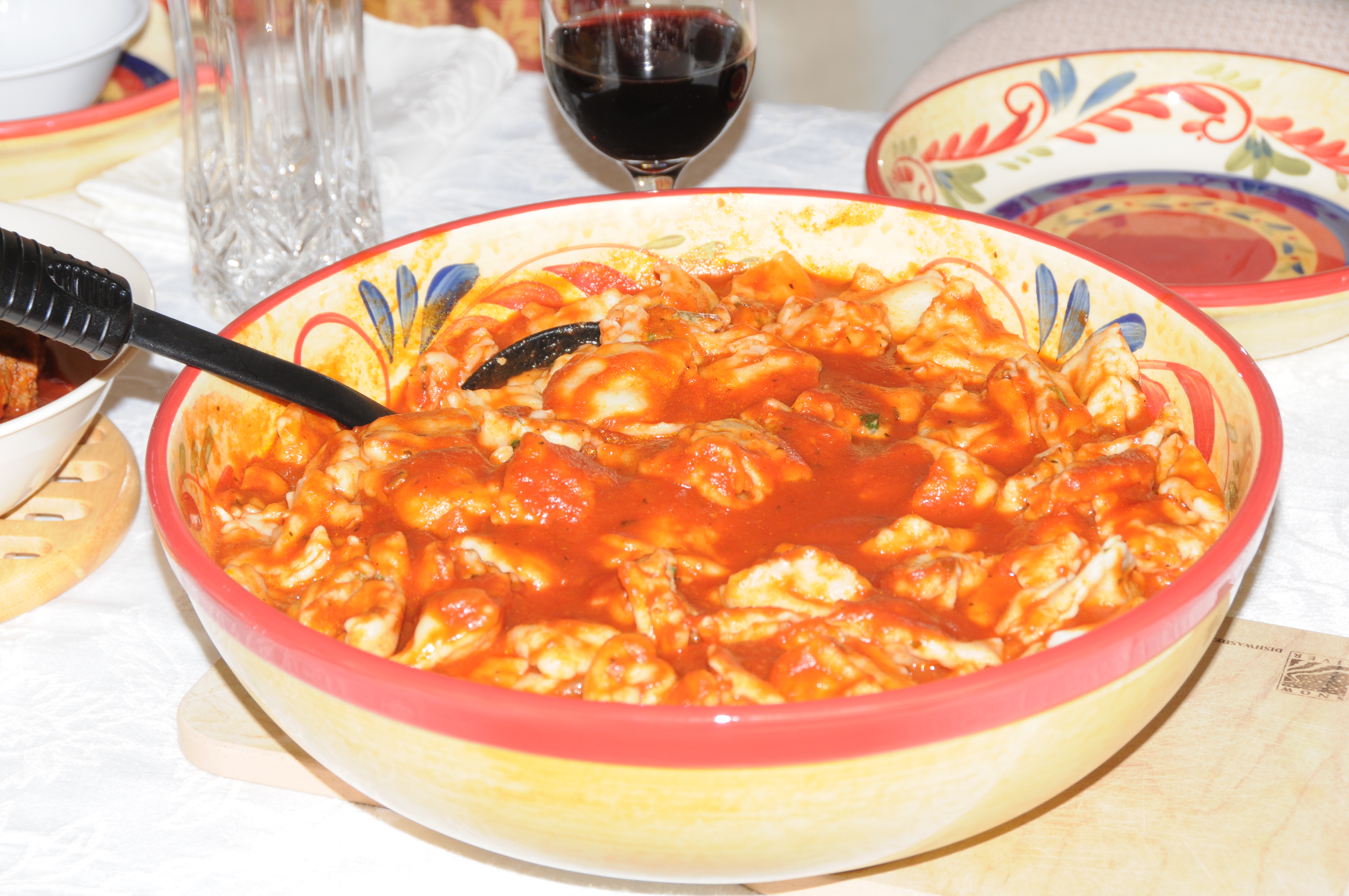
Looks plain, but you have no idea ...
So how do you make these fabled ravioli? Well, the easiest way is to make it with him. g and I have done this, acting as his helpers. I noted that no single action is particularly “hard” or “difficult” or “impossible” – but doing it “just right” requires a certain finesse that apparently only comes with years of practice, a commitment to perfectionism, and a “critical” eye to recognize when something’s working well or needs to be tweaked. It requires a ravioli “marker” (think rolling pin with divots to shape the ravioli), a piece of equipment that no Williams Sonoma or Kitchen Kapers carries. Finally, the ingredients are very specific – there is a very particular way in which the ground veal must be sourced (so I’ve been told). The flour: it absolutely must be Pillsbury brand all-purpose flour.
Unfortunately, if I told you anything more, I’d certainly have to kill you …
Pasta with Wine-Marinated Short Rib Ragu
t says: Just the other day (over a year ago), g and I received a Williams Sonoma catalog in the mail. On the cover, there was the most beautiful piece of cookware I had ever seen. It was the “slate” Le Creuset Dutch oven. The color screamed chic and classic at the same time. The thing is … I didn’t really know how to “use” a dutch oven. Wasn’t it just a super-heavy pot – why would anyone want one of those? Perhaps it’s just a status symbol (like All-Clad and Viking)? Fast forward to June 2009 – my parents found out that I had perused Dutch ovens at one time and purchased for me a beautiful red Le Creuset for my bday. Trust me, I liked the red one a lot (I love the color red in general – I used to have a bright red pair of shoes and am on the lookout for a new pair of bright red shoes), but I was let down that slate was no longer available at WS (curse them and their “limited edition” colors). Interestingly, k and her then-fiance/now-husband, cm, showed us their recently acquired Dutch oven at that time – it was the SLATE one! Apparently, the WS they had visited happened to be clearing them out (thus, while online availability was nil, I guess some stores still had stock – but I couldn’t find any). Fiddlesticks – I knew that the search for slate was over (unless I wanted a tiny slate saucier, which was the only thing ever in stock) …
Because I was still a neophyte to the wonderful world of enameled cast iron, I decided to do some research (and looked for alternative colors and brands). I ended up browsing a line of cookware from Staub – the “other” French Dutch oven company with quite a following of devout anti-Le Creuset-ists (I kinda liked that). I was impressed with the black interior and self-basting “spikes” (although sometimes I wonder if this is a gimmick because Thomas Keller and Molly Stevens both recommend parchment paper to line the lids of their braising vessels), but when I saw that they were just releasing a new, limited edition “titanium gray” color, I knew it was made for me. I swapped the red Le Creuset for the titanium gray Staub (6.5 qt – it isn’t as classic as the slate, but, because it reminds me of a brand new dark gray bmw, it has more bling). I also immediately invested in a copy of All About Braising, as what is the purpose of having a piece of cookware but not knowing how to use it? Over the ensuing 6 months, I braised everything – chicken, beef, pork, vegetables, seafood (although the latter two required a smaller vessel – so I used our other cookware). The following is my favorite recipe thus far (probably because I <3 short ribs) and is adapted from recipes by Molly Stevens and Giada De Laurentiis, with a fine point or two from Thomas Keller. This dish has finally allowed me to see a short rib recipe on a restaurant menu and NOT automatically order it (I <3 short rib), as now I know I can make a respectable version at home (although definitely NOT fancy – very “rustic”).
Ingredients:
the spiced EtOH:
__ 1 bottle of tasty, inexpensive red wine (For this, I like something a little less “fruity” – not Australian Shiraz or Argentinian Malbec, rather, something a bit more rustic, like some Sangiovese-based Italian blend or dip into Spain. I personally don’t opt for Chianti because I’ve run into a lot of bad Chiantis until I started getting up into the Chianti Classico range at $20+ … which is WAY too much $$ for a recipe like this. In short, pick a red wine you want to drink that isn’t insanely fruity.)
__ 1 tsp black peppercorns
__ 0.5 tsp allspice berries (optional)
__ 4 whole cloves (optional)a few rosemary sprigs
__ 2 bay leaves, broken in half
__ 1 tsp kosher salt
__ Cheesecloth and kitchen string (optional)
the meat:
__ ~3.5 lbs of beef short ribs bone-in (not thinly sliced)
__ Kosher salt and pepper
__ <0.5 c olive/canola oil mix (olive oil adds nice flavor, but smokes a lot – canola oil is neutral, but has a much higher smoke point – so I go 50/50, but sane people can just use whatever oil they want! I hear grapeseed oil is good for frying, too!)
the braise:
__ 1 large onion (for this, I prefer sweet and yellow onions > white onions > red onions), diced
__ 4 cloves garlic, minced (I prefer fresh to jarred)
__ 5 roma/plum tomatoes, cut into large dice (or 4 if they seem exceptionally large, or 6 if you REALLY like tomato)
__ 2 Tbs Dijon mustard
__ <2 c beef stock (I used Kitchen Basics “Unsalted”)
the finish:
__ 0.75 lb pasta (medium-sized shape like penne, farfalle, or, my favorite, cellentani) – if using a small shape like elbows, use 1 lb
__ 1 small bag of frozen peas (you won’t use the whole bag)
__ some Italian parsley (optional)
__ Grated Parmigiano Reggiano and/or Pecorino Romano (I probably use ~0.3333333333 c of each, but I just buy a small block of each, and grate it as needed to taste/texture – feel free to use one or the other depending on which you prefer or is available)
Methods:
-1) To marinate or not to marinate? If you know you’re going to make the dish well in advance, you could marinate the beef the day before. Unfortunately, not everyone is able to do this. I’ll pretend that you don’t and then make recommendations afterwards if you do. So … if you are going to cook all of this in one day … Gently pour 1.5 cups of wine into a saucepan. Slowly turn up the heat until the wine just reaches a boil. Turn off the heat. When the wine stops bubbling, add peppercorns, allspice, cloves, rosemary, bay leaves, and 1 tsp kosher salt. Stir. Proceed to step 0 as the pot cools.
Words of wisdom re: Step -1:
a) If you have cheesecloth, you may instead bundle the herbs/spices into a satchel tied off with kitchen string, and add the satchel to the heated wine (like a tea bag). I have no cheesecloth, so I instead will just strain the herbs/spices after I’m done.
b) If you’re going to marinate your meat overnight, start with a larger volume of wine (~3 cups). Then, after the wine cools to room temperature, pour it into a high quality 1 gallon plastic bag (one you would bet your fridge on). Seal the bag with as little air as possible, place the bag into a large bowl (to prevent spills), and place the bowl into the fridge to cool for ~1 hour. Add the short ribs to the bagged wine and seal the bag with as little air as possible. Return the sealed bag-o-meat-and-wine to a safety bowl in the fridge. Marinate in refrigerator for 24-36 hours, turning at least once to ensure that all of the meat is submerged in wine at one point or another.
c) Any remaining wine will be useful to sip as you continue with the braise.
0) Brace yourself. Preheat oven to 315 degrees. Slowly heat Dutch oven or some other wide, lidded, oven-proof pot (mine is 28 cm in diameter – the smallest size capable of holding all of the ingredients for this recipe is ~5 quarts) on the stovetop to medium-high heat. Pour yourself a glass of wine and buckle up for some cooking! N.B. If you marinated the meat, remove the ribs from the marinade (ensuring no peppercorns, cloves, etc are stuck to the meat), pat the meat dry, and reserve 1 cup of the marinade (liquid-only – no herbs, spices, etc) – do NOT accidentally drink it.
1) Sear the meat. Season the short ribs with kosher salt and pepper. Next, add enough oil to the heated Dutch oven to just cover the bottom. Brown the ribs (in batches) in the Dutch oven on all sides until beautifully crusted; set aside all ribs. When you’re on your last side of your last batch of ribs, turn the heat down to medium-low.
2) Assemble the braising base. Add onions to the cooking vessel and keep them moving to avoid burning; cook until translucent. Add garlic and mix. As the garlic becomes fragrant (~30 seconds), add half of the tomatoes and them down until the tomatoes start getting softer. Add the rest of the tomatoes, and cook until all the tomatoes are soft. Add 1 cup of the spiced wine (i.e. reserved marinade) – there should be NO herbs/particles in it, as they’ll be a pain to remove later. Mix and scrape the bottom of the pan with a wooden/plastic/nylon spatula to release the “brown bits”. Cook until the new liquid (from the wine and tomatoes) reduces in half (a few minutes depending on how hot the vessel was). Add the mustard; mix to combine and cook until simmering again.
3) Bring on the meat. Nestle the ribs into the Dutch oven. Add beef broth until the total liquid in the pot reaches half-way up the ribs. Place lid on the vessel (if your lid doesn’t have re-basting spikes or is not completely flush, put a sheet of parchment paper between the lid and the vessel). Place into oven.
4) Set the temperature. Check on the vessel in 15 minutes. If the bubbling is any more than a “very light simmer”, reduce the heat by 10 degrees and check again in 15 minutes. Continue reducing heat in this manner until the desired bubbling is achieved. After 1 hour of cooking, flip the short ribs. Total cooking time will be ~3 hours or until the meat easily pulls away from the bone and is fork-tender (if you can’t poke a spoon through the meat, it’s not done yet). Enjoy that glass of wine while you wait …
5) Make the pasta sauce. Remove the ribs from the cooking liquid, and set aside under a foil tent. Let the cooking vessel sit for a few minutes, and, using a large spoon, remove any excess fat from the surface of the cooking liquid. Alternatively, a gravy separator would also be handy. Using a ladle, transfer the entirety of the remaining cooking liquid into the bowl of a food processor or blender. Process/blend until the mixture is smooth sauce. An alternative is to simply let the vessel cool, stick it in the fridge overnight, remove the congealed fat the next day with a spoon, and then sticking the vessel it straight back into the oven at a low temp just to re-heat it before proceeding to step 6. Meats braised like the short ribs in this recipe often benefit from a night in the fridge!
6) Make the pasta. Cook your pasta of choice as you perform step 7. Use a timer so you don’t accidentally overcook your pasta (step 7 is very distracting). Reserve 1 cup of the pasta cooking water when done.
7) Disassemble the meat. Remove the meat from the bones. Using 2 forks, shred the meat into smaller pieces. Some may also want to remove large pieces of fat as well – do as you please.
8) Ta-da! In a serving bowl, combine pasta, the sauce, and the meat. If the sauce needs to be thinned (which it hasn’t for me, ever), add some of the reserved pasta water (but be careful, because you might have salted the pasta water – and both of the cheeses could be salty). Add frozen peas until the desire pasta:pea ratio is reached. Add grated cheese(s) until the sauce takes on a creamy, cheesy texture and the desired taste. Season with salt and pepper if necessary (given these cheeses, you’ll likely not need much of the former). Add chopped parsley until desired parsley density is reached (adds a little vegetal zing to the dish … I find it unnecessary).

 after dinner sneeze